Today's
EarthStation1.com 15% Off Commemorative Memorial Title: Is There
One Who Understands Me? The World Of James Joyce DVD MP4 USB
Today, May 12, 2026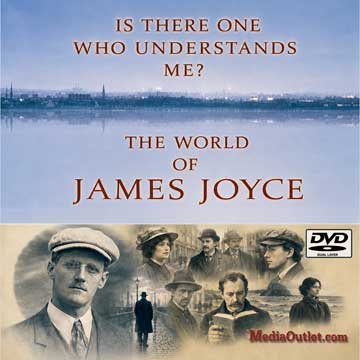
May 12: National Limerick Day: --
Celebrates the birthday of English artist, illustrator, author,
and poet Edward Lear (May 12, 1812 - Jan. 29, 1888). Lear is known
mostly for his literary nonsense in poetry, prose, and limericks,
often writing with made-up words, telling tales of
"Quangle-Wangles," and "runcible spoons." He
wrote 212 limericks, most of which didn't follow the specific
rhyming rules of the style. Although the by definition limericks
have five lines, Lear's were often shown in three or four, to give
space to his accompanying illustrations and drawings. (A favorite
of his: "There was an Old Man of Peru, who watched his wife
making a stew; But once by mistake, In a stove she did bake, That
unfortunate Man of Peru.") The origin of the poem's name is a
bit disputed, but most people believe it comes from the Irish city
of Limerick. With just fine lines, the first two rhyming with the
fifth line, and third and fourth lines rhyming together, limericks
are quick, funny poems. Although popularized by Lear, limericks
first started to emerge in England in the 18th century. Most
limericks begin by describing a person and place, and then the
rest of the lines describe that person's actions. Limericks can be
vulgar or crude, and are often inappropriate. Lear liked it that
way-he considered "clean" limericks to be average at
best. More recent limericks have turned toward current events and
social issues. On Sale @ 15% Off Discount Till Midnight PT!
https://store.earthstation1.com/is-there-one-who-understands-me-the-world-of-james-joyce-dvd.html
Today's
EarthStation1.com 15% Off Commemorative Memorial Title: Pioneers
Of Surgery Documentary TV Series DVD, MP4 Download, USB Drive
Today, May 12, 2026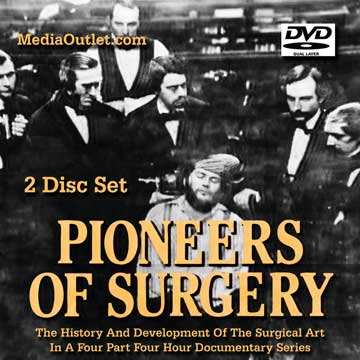
May 12: National Hospital Day: -- Aims to
educate the public about medical examinations and treatments.
Officially declared by former U.S. President Warren G. Harding,
the holiday was observed for the first time on May 12, 1921. The
idea was conceived by Matthew O. Foley, a Chicago-based editor, as
a way to reawaken public trust and confidence in the medical
sector in the aftermath of the deadly Spanish Flu, which claimed
millions of lives. May 12 was chosen as the date to commemorate
the birthday of Florence Nightingale, known as the founder of
modern nursing. National Hospital Day was observed for the first
time in 1921 to commemorate the birthday of Florence Nightingale,
the founder of modern nursing. She set standards for nursing
during the Crimean War of 1854. The idea behind the holiday was
conceived by Matthew O. Foley, a managing editor of the
Chicago-based magazine "Hospital Management." Foley's
motive was to renew public confidence in hospitals in the wake of
the deadly Spanish Flu pandemic of 1918, which claimed about 50
million lives worldwide. Former U.S. President Warren G. Harding
officially declared the holiday in 1921.In honor of Nightingale,
hospitals across the United States and Canada were to open their
doors to visitors to educate them about medical examination and
treatment, while using the opportunity to share healthcare
literature and information about nursing schools. In 1941, posters
were put up on 12 Casper store windows, containing the slogan
"Hospitals - Guardians of Health." In 1953, National
Hospital Day expanded to become National Hospital Week to provide
hospitals with more time to educate and inform the public about
healthcare. Currently, the holiday is sponsored by the American
Hospital Association. Britannica defines a hospital as "an
institution that is built, staffed, and equipped for the diagnosis
of disease; for the treatment, both medical and surgical, of the
sick and the injured; and for their housing during this process.
The modern hospital also often served as a center for
investigation and for teaching." On Sale @ 15% Off Discount
Till Midnight PT!
https://store.earthstation1.com/pioneers-of-surgery-dvd-set-4-episode-tv-series-2-dis42.html
Today's
EarthStation1.com 15% Off Commemorative Memorial Title: The Old
Time Radio Drama MP3 MegaSet DVD, Audio Download, USB Stick
Today, May 12, 2026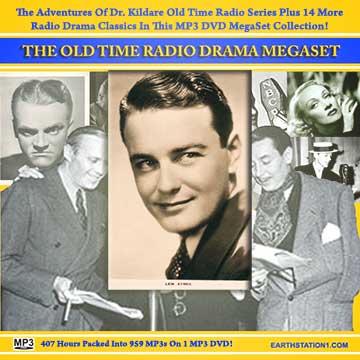
May 12: International Nurses Day: -- Some
of them had beloved nurses as children, while others coiled at the
sight of blue scrubs. Some had sweet smiles and soft expressions,
and they never forgot our treat as we walked out the door. While
others had warmer grins and kinder faces, it reminded us of the
day we were jabbed in the eye with a sharp syringe while looking
out the window. We know it was all for the best, though. Nurses
are the backbone of the healthcare sector, dressed in scrubs,
stethoscopes in their pockets, and a doctor's most trusted ally.
Caring for someone has changed over time. While official education
and training for this have only been available for a few
centuries. Only a wet nurse and a midwife performed nursing tasks
at first. It wasn't until the 16th Century that it came to be
defined as someone who looks after the sick, as it is now.
Florence Nightingale was the first to establish what is now
considered contemporary nursing procedures. She was born in
Florence, Italy, and was given the name Florence. She was a nurse
during the Crimean War and used what she learned there to create a
holistic nursing system when she returned home. She earned the
nickname 'the Lady with the Lamp' during the war because she was
known for injuring soldiers at night. Nightingale was a prolific
writer who shared nursing methods through her writing. She was
also a skilled statistician, presenting her findings and drawing
conclusions using data and charts. One of the first forms of a pie
chart was created by her. In 1870, she established the first
secular nursing school. It was in collaboration with St. Thomas'
Hospital in London - which is now part of King's College. She
instituted several hygiene and sanitation procedures, including
the use of the nurse's cap. Florence Nightingale was a modern
nursing pioneer, and her birthday is commemorated as International
Nursing Day. On Sale @ 15% Off Discount Till Midnight PT!
https://store.earthstation1.com/the-old-time-radio-drama-mp3-dvd-megase3.html
Today's
EarthStation1.com 15% Off Commemorative Memorial Title: The
American Adventure: TV History Series 1607-1876 DVD MP4 USB Drive
Today, May 12, 2026
May 12, 1784: The Age Of Enlightenment
(The Enlightenment, The Age Of Reason): The Age Of Revolution: The
Atlantic Revolutions: The American Enlightenment: The American
Revolution: The American Revolutionary War: The Treaty Of Paris
(1783):The Aftermath Of The American Revolution: The Treaty Of
Paris (1783) Effective Date: -- The Treaty Of Paris signed on
September 3, 1783, takes effect on this date, ending the American
Revolutionary War. The Treaty Of Paris, signed in Paris by
representatives of King George III of Great Britain and
representatives of the United States of America, set the terms of
the withdrawal of British Forces from the states, set boundaries
between the British Empire in North America and the United States,
and details fishing rights, restoration of property and prisoners
of war. This treaty and the separate peace treaties between Great
Britain and the nations that supported the American cause -
France, Spain, and the Dutch Republic - are known collectively as
the Peace of Paris. Only Article 1 of the treaty, which
acknowledges the United States' existence as free sovereign and
independent states, remains in force. On Sale @ 15% Off Discount
Till Midnight PT!
https://store.earthstation1.com/the-american-adventure-series-us-1st-century-4-dv14.html
Today's
EarthStation1.com 15% Off Commemorative Memorial Title: Vidal in
Venice - Gore Vidal's TV Venetian History DVD, Download, USB
Today, May 12, 2026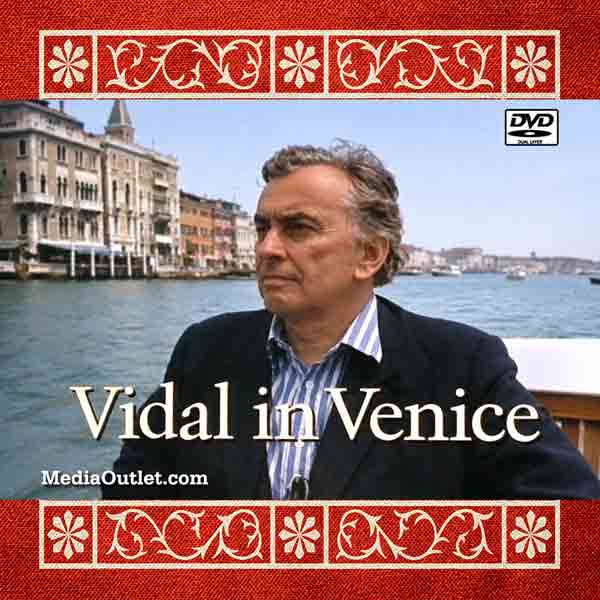
May 12, 1797: The Age Of Enlightenment
(The Enlightenment, The Age Of Reason): The Age Of Revolution: The
Atlantic Revolutions: The French Revolution: The French
Revolutionary And Napoleonic Wars (The Great French War) (The
French Revolutionary Wars, The Napoleonic Wars): The Napoleonic
Wars: The Coalition Wars: The War Of The First Coalition:
Campaigns Of 1797 In The French Revolutionary Wars: Napoleon's
Conquest Of Venice: -- The ancient Republic of Venice is conquered
by Napoleon Bonaparte, resulting in its partition between Austria
and France following their signing The Treaty Of Campo Formio on
October 17. 1797. This ended the War of the First Coalition,
although Great Britain and France remained at war. The Treaty of
Campo Formio also resulted in Austria ceding Belgium and the
Austrian Netherlands to France, and recognized French control of
the Rhineland, as well as Lombardy and much of the rest of Italy.
Although Britain remained at war with France, The Treaty Of Campo
Formio effectively ended the First Coalition. Austria later signed
the Treaty of Campo Formio. During the 18th century, Venice became
perhaps the most elegant and refined city in Europe, greatly
influencing art, architecture, and literature. But the Republic
lost its independence when Napoleon Bonaparte conquered Venice.
Napoleon was seen as something of a liberator by the city's Jewish
population. He removed the gates of the Ghetto and ended the
restrictions on when and where Jews could live and travel in the
city. Austria signed the Treaty of Campo Formio on October 12,
1797, ceding Belgium to France, recognizing French control of the
Rhineland and much of Italy, and partitioning the ancient Republic
of Venice between Austria and France. This ended the War of the
First Coalition, although Great Britain and France remained at
war. The Austrians took control of Venice on January 18, 1798.
Venice was taken from Austria by the Treaty of Pressburg in 1805
and became part of Napoleon's Kingdom of Italy. It was returned to
Austria following Napoleon's defeat in 1814, when it became part
of the Austrian-held Kingdom of Lombardy-Venetia. In 1848 a revolt
briefly re-established the Venetian republic under Daniele Manin,
but this was crushed in 1849. In 1866, after the Third Italian War
of Independence, Venice, along with the rest of the Veneto, became
part of the newly created Kingdom of Italy. On Sale @ 15% Off
Discount Till Midnight PT!
https://store.earthstation1.com/vidal-in-venice-dvd-gore-vidal-venetian-history-2-part-tv-serie2.html
Today's
EarthStation1.com 15% Off Commemorative Memorial Title: WWII
Films: Combat Medicine And Post War Plans DVD, MP4, USB Drive
Today, May 12, 2026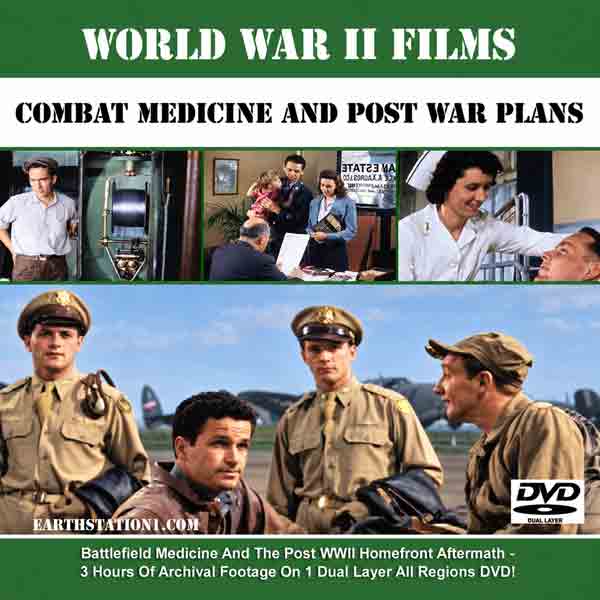
May 12, 1820: #BOTD: #HBD! Florence
Nightingale OM (The Order Of Merit) RRC (The Royal Red Cross) DStJ
(The Most Venerable Order Of The Hospital Of Saint John Of
Jerusalem), celebrated Italian-English social reformer,
statistician, mystic, icon of Victorian culture and the founder of
modern nursing, nicknamed "The Lady With The Lamp"
because of her habit of making rounds of wounded soldiers at
night, who gave nursing a favourable reputation and came to
prominence while serving as a manager and trainer of nurses during
the Crimean War, in which she organised care for wounded soldiers
at Constantinople, significantly reduced death rates by improving
hygiene and living standards (d. August 13, 1910) is #born into a
wealthy and well-connected British family at the Villa Colombaia
in Florence, Tuscany, Italy, and was named after the city of her
birth. Recent commentators have asserted that Nightingale's
Crimean War achievements were exaggerated by the media at the
time, but critics agree on the importance of her later work in
professionalising nursing roles for women. In 1860, she laid the
foundation of professional nursing with the establishment of her
nursing school at St Thomas' Hospital in London. It was the first
secular nursing school in the world and is now part of King's
College London. In recognition of her pioneering work in nursing,
the Nightingale Pledge taken by new nurses, and the Florence
Nightingale Medal, the highest international distinction a nurse
can achieve, were named in her honour, and the annual
International Nurses Day is celebrated on her birthday. Her social
reforms included improving healthcare for all sections of British
society, advocating better hunger relief in India, helping to
abolish prostitution laws that were harsh for women, and expanding
the acceptable forms of female participation in the workforce.
Nightingale was a pioneer in statistics; she represented her
analysis in graphical forms to ease drawing conclusions and
actionables from data. She is famous for usage of the polar area
diagram, also called the Nightingale rose diagram, equivalent to a
modern circular histogram. This diagram is still regularly used in
data visualisation. Nightingale was a prodigious and versatile
writer. In her lifetime, much of her published work was concerned
with spreading medical knowledge. Some of her tracts were written
in simple English so that they could easily be understood by those
with poor literary skills. She was also a pioneer in data
visualisation with the use of infographics, using graphical
presentations of statistical data in an effective way. Much of her
writing, including her extensive work on religion and mysticism,
has only been published posthumously. Despite being born and
raised a Unitarian, Nightingale's own (rare) references to
conventional Unitarianism are mildly negative. She remained in the
Church of England throughout her life, albeit with unorthodox
views. Influenced from an early age by the Wesleyan Methodist
Tradition, Nightingale felt that genuine religion should manifest
in active care and love for others. She wrote a work of theology,
"Suggestions For Thought", her own theodicy (a
philosophy of religion that attempts to resolve the existence of
evil in a universe where all power and goodness are ascribed to
God), which develops her heterodox (other than orthodox) religious
ideas. Nightingale questioned the goodness of a God who would
condemn souls to hell, and was a believer in universal
reconciliation - the concept that even those who die without being
"saved" will nonetheless eventually make it to heaven.
She would sometimes comfort those in her care with this view. For
example, a dying young prostitute being tended by Nightingale was
concerned she was going to hell, and said to her "Pray God,
that you may never be in the despair I am in at this time"'
Nightingale replied "Oh, my girl, are you not now more
merciful than the God you think you are going to? Yet the real God
is far more merciful than any human creature ever was or can ever
imagine." Florence Nightingale died peacefully in her sleep
in her room at 10 South Street, Mayfair, London at the age of 90.
The offer of burial in Westminster Abbey was declined by her
relatives, and she is buried in the churchyard of St Margaret's
Church in East Wellow, Hampshire, near Embley Park with a memorial
with just her initials and dates of birth and death. She left a
large body of work, including several hundred notes that were
previously unpublished. A memorial monument to Nightingale was
created in Carrara marble by Francis William Sargant in 1913 and
placed in the cloister of the Basilica of Santa Croce, in
Florence, Italy. On Sale @ 15% Off Discount Till Midnight PT!
https://store.earthstation1.com/wwii-films-medicine-the-americas-and-post-war-plans-dvd.html
Today's
EarthStation1.com 15% Off Commemorative Memorial Title: The Old
Time Radio Western MegaSet MP3 Collection DVD, Download, USB
Today, May 12, 2026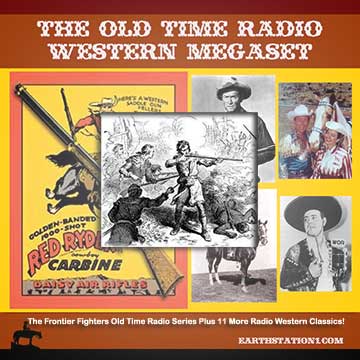
May 12, 1846: The United States: The
History Of The United States: United States Expansionism: American
Imperialism: Manifest Destiny: Cannibalsim: The Donner Party (The
Donner-Reed Party): -- The Donner Party, sometimes called the
Donner-Reed Party, a group of American pioneers who migrated to
California in a wagon train, departs Independence, Missouri, for
California, on what will become a year-long journey of hardship
and cannibalism. Delayed by a multitude of mishaps, they spent the
winter of 1846-1847 snowbound in the Sierra Nevada. Some of the
migrants resorted to cannibalism to survive, mainly eating the
bodies of those who had succumbed to starvation, sickness, or
extreme cold, but in one case murdering and eating two Miwok
guides. The Donner Party originated from Springfield, Illinois,
and departed Independence, Missouri, on the Oregon Trail in the
spring of 1846. The journey west usually took between four and six
months, but the Donner Party was slowed after electing to follow a
new route called the Hastings Cutoff, which bypassed established
trails and instead crossed the Rocky Mountains' Wasatch Range and
the Great Salt Lake Desert in present-day Utah. The desolate and
rugged terrain, and the difficulties they later encountered while
traveling along the Humboldt River in present-day Nevada, resulted
in the loss of many cattle and wagons, and divisions soon formed
within the group. By early November, the migrants had reached the
Sierra Nevada but became trapped by an early, heavy snowfall near
Truckee Lake (now Donner Lake) high in the mountains. Their food
supplies ran dangerously low, and in mid-December some of the
group set out on foot to obtain help. Rescuers from California
attempted to reach the migrants, but the first relief party did
not arrive until the middle of February 1847, almost four months
after the wagon train became trapped. Of the 87 members of the
party, 48 survived. Historians have described the episode as one
of the most fascinating tragedies in California history and in the
record of American westward migration. On Sale @ 15% Off Discount
Till Midnight PT!
https://store.earthstation1.com/the-old-time-radio-western-megaset-dual-layer-mp3-dv3.html
Today's
EarthStation1.com 15% Off Commemorative Memorial Title: Between
The Wars TV Documentary Series DVD, Video Download, USB Drive
Today, May 12, 2026
May 12, 1850: #BOTD: Henry Cabot Lodge,
American Republican Congressman and historian from Massachusetts
(d. November 9, 1924) is #born in Beverly, Massachusetts into the
Boston Brahmin family of John Ellerton Lodge of the the Boston
Brahmin Lodge family and Anna Cabot of the Boston Brahmin Cabot
family. Through his mother he was a great-grandson of George Cabot
(1751 or 1752 - April 18, 1823), American merchant, seaman, and
politician from Massachusetts who represented the state as a U.S.
Senator, a major figure in the Hamiltonian faction of the
Federalist Party and was a vocal supporter of war with
Revolutionary France, and was the presiding officer of the
infamous Hartford Convention, which discussed removing the
three-fifths compromise and requiring a two-thirds majority in
Congress for the admission of new states, declarations of war, and
creating laws restricting trade, and discussed their grievances
with the Louisiana Purchase and the Embargo of 1807, all of which
were contributing factors to the downfall of the Federalist Party.
Henry Cabot Lodge was also a cousin of American polymath Charles
Peirce, scientist, mathematician, logician, and philosopher known
as "The Father Of Pragmatism", who according to
philosopher Paul Weiss was "the most original and versatile
of America's philosophers and America's greatest logician",
and of whom Bertrand Russell wrote "he was one of the most
original minds of the later nineteenth century and certainly the
greatest American thinker ever". Henry Cabot Lodge grew up on
Boston's Beacon Hill and spent part of his childhood in Nahant,
Massachusetts, where he witnessed the 1860 kidnapping of a
classmate and gave testimony leading to the arrest and conviction
of the kidnappers. When the Civil War broke out in 1861, Lodge's
father wanted to ride into battle at the head of a cavalry
regiment he had personally put together, but his father missed the
chance, possibly due to a bad knee from a riding injury, and in
September 1862, Lodge's father suddenly died. In 1872, Henry Cabot
Lodge graduated from Harvard College, where he was a member of
Delta Kappa Epsilon, the Porcellian Club, and the Hasty Pudding
Club. In 1874, he graduated from Harvard Law School, and was
admitted to the bar in 1875, practicing at the Boston firm now
known as Ropes & Gray. A member of the prominent Lodge family,
he received his PhD in history from Harvard University. He is best
known for his positions on foreign policy, especially his battle
with President Woodrow Wilson in 1919 over the Treaty Of
Versailles. The failure of that treaty ensured that the United
States never joined the League Of Nations. Born in Beverly,
Massachusetts, Lodge won election to the Massachusetts House of
Representatives after graduating from Harvard. He and his close
friend, Theodore Roosevelt, opposed James G. Blaine's nomination
at the 1884 Republican National Convention, but supported Blaine
in the general election against Grover Cleveland. Lodge was
elected to the United States House Of Representatives in 1886
before joining the United States Senate in 1893. In the Senate, he
sponsored the unsuccessful Lodge Bill, which sought to protect the
voting rights of African Americans. He supported the
Spanish-American War and called for the annexation of the
Philippines after the war. He also supported immigration
restrictions, becoming a member of the Immigration Restriction
League and influencing the Immigration Act of 1917. Lodge served
as Chairman of the 1900 and 1908 Republican National Conventions.
A member of the conservative wing of the Republican Party, Lodge
opposed Roosevelt's third party bid for president in 1912, but the
two remained close friends. During the presidency of Woodrow
Wilson, Lodge advocated entrance into World War I on the side of
the Entente Powers. He became Chairman of the Senate Republican
Conference and Chairman of the Senate Committee on Foreign
Relations, emerging as the leader of the Senate Republicans. He
led the opposition to Wilson's Treaty Of Versailles, proposing
twelve reservations to the treaty. He most strongly objected to
the provision of the treaty that required all nations to repel
aggression, fearing that this would erode Congressional powers and
commit the U.S. to burdensome obligations. Lodge prevailed in the
treaty battle and Lodge's objections would influence the United
Nations, the successor to the League Of Nations. After the war,
Lodge participated in the creation of the Washington Naval Treaty,
which sought to prevent a naval arms race. He remained in the
Senate until his death at the age of 74 of a severe stroke he had
four days earlier while recovering in the hospital from surgery
for gallstones. He is buried in the Mount Auburn Cemetery in
Cambridge, Massachusetts. On Sale @ 15% Off Discount Till Midnight
PT!
https://store.earthstation1.com/between-the-wars-dvd-set-all-16-tv-shows-4-discs164.html
Today's
EarthStation1.com 15% Off Commemorative Memorial Title: Ulysses S.
Grant & The Battle Of The Wilderness DVD MP4 USB Drive
Today, May 12, 2026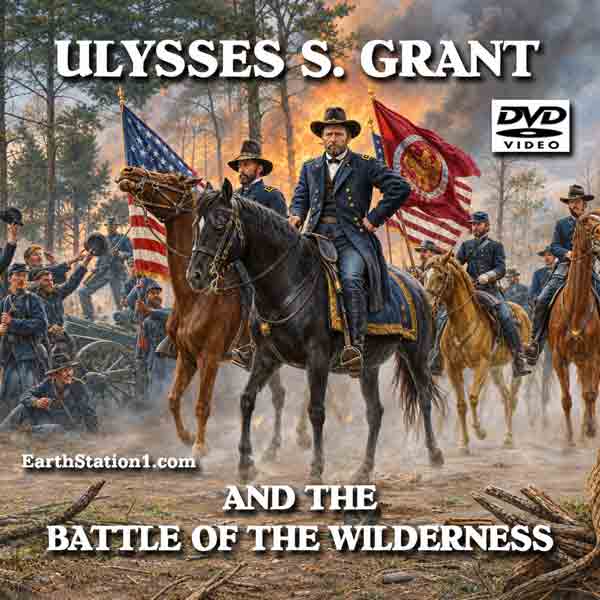
May 12, 1864: The American Civil War (The
Civil War, The War Between The States): The Eastern Theater Of The
American Civil War: The Overland Campaign (Grant's Overland
Campaign, The Wilderness Campaign): The Battle Of Spotsylvania
Court House (The Battle Of Spotsylvania, The Battle Of
Spottsylvania Court House, The Battle Of Spottsylvania): --
Thousands of Union and Confederate soldiers die in "the
Bloody Angle" in almost 24 hours of desperate hand-to-hand
fighting, some of the most intense of the Civil War. The Battle Of
Spotsylvania Court House (May 9-21, 1864), sometimes more simply
referred to as the Battle Of Spotsylvania (or the 19th-century
spelling Spottsylvania), was the second major battle in Lt. Gen.
Ulysses S. Grant and Maj. Gen. George G. Meade's 1864 Overland
Campaign of the American Civil War. Following the bloody but
inconclusive Battle Of The Wilderness, Grant's army disengaged
from Confederate General Robert E. Lee's army and moved to the
southeast, attempting to lure Lee into battle under more favorable
conditions. Elements of Lee's army beat the Union army to the
critical crossroads of the Spotsylvania Court House in
Spotsylvania County, Virginia, and began entrenching. Fighting
occurred on and off from May 8 through May 21, 1864, as Grant
tried various schemes to break the Confederate line. In the end,
the battle was tactically inconclusive, but both sides declared
victory. The Confederacy declared victory because they were able
to hold their defenses. The United States declared victory because
the Federal offensive continued and Lee's army suffered losses
that could not be replaced. With almost 32,000 casualties on both
sides, Spotsylvania was the costliest battle of the campaign.
========= May 12, 1864: May 12, 1864: #DOTD: J. E. B. Stuart,
United States Army officer from the U.S. state of Virginia, who
later became a Confederate States Army general during the American
Civil War (b. February 6, 1864) #dies at 7:38 p.m. of a
.44-caliber gunshot wound of the day prior at the Battle Of Yellow
Tavern, fired by retreating 5th Michigan Cavalry private John A.
Huff, who shot Stuart with his revolver from a distance of 10-30
yards, striking Stuart in the left side, slicing through his
stomach and exiting his back, one inch to the right of his spine.
He was 31 years old. He suffered great pain as an ambulance took
him to Richmond to await his wife's arrival at the home of Dr.
Charles Brewer, his brother-in-law. Stuart ordered his sword and
spurs be given to his son. Confederate President Jefferson Davis
came to his side, took General Stuart's hand, and asked, "General,
how do you feel?" Stuart answered "Easy, but willing to
die, if God and my country think I have fulfilled my destiny and
done my duty." His last whispered words were: "I am
resigned; God's will be done." He died the following day,
before Flora Stuart reached his side. Stuart was buried in
Richmond's Hollywood Cemetery. Upon learning of Stuart's death,
General Lee is reported to have said that he could hardly keep
from weeping at the mere mention of Stuart's name and that Stuart
had never given him a bad piece of information. Stuart's wife
Flora wore the black of mourning for the remainder of her life,
and never remarried. John Huff, the private who had fatally
wounded Stuart, was killed in action just a few weeks later at the
Battle of Haw's Shop. J. E. B. Stuart was born James Ewell Brown
Stuart at Laurel Hill Farm, a plantation in Patrick County,
Virginia, near the border with North Carolina. He was known to his
friends as "Jeb", from the initials of his given names.
Stuart was a cavalry commander known for his mastery of
reconnaissance and the use of cavalry in support of offensive
operations. While he cultivated a cavalier image (red-lined gray
cape, yellow sash, hat cocked to the side with an ostrich plume,
red flower in his lapel, often sporting cologne), his serious work
made him the trusted eyes and ears of Robert E. Lee's army and
inspired Southern morale. Stuart graduated from West Point in
1854, and served in Texas and Kansas with the U.S. Army. He was a
veteran of the frontier conflicts with Native Americans and the
violence of Bleeding Kansas, and he participated in the capture of
John Brown at Harpers Ferry. He resigned when his home state of
Virginia seceded to serve in the Confederate Army, first under
Stonewall Jackson in the Shenandoah Valley, but then in
increasingly important cavalry commands of The Army Of Northern
Virginia, playing a role in all of that army's campaigns until his
death. He established a reputation as an audacious cavalry
commander and on two occasions (during the Peninsula Campaign and
the Maryland Campaign) circumnavigated the Union Army Of The
Potomac, bringing fame to himself and embarrassment to the North.
At the Battle of Chancellorsville, he distinguished himself as a
temporary commander of the wounded Stonewall Jackson's infantry
corps. Arguably Stuart's most famous campaign, Gettysburg, was
marred when he was surprised by a Union cavalry attack at the
Battle Of Brandy Station and by his separation from Lee's army for
an extended period, leaving Lee unaware of Union troop movements
and contributing to the Confederate defeat at the Battle Of
Gettysburg. Stuart received significant criticism from the
Southern press as well as the postbellum proponents of the Lost
Cause movement, but historians have failed to agree on whether
Stuart's exploit was entirely the fault of his judgment or simply
a result of bad luck and Lee's less-than-explicit orders. During
the 1864 Overland Campaign, Union Maj. Gen. Philip Sheridan's
cavalry launched an offensive to defeat Stuart, who was mortally
wounded at the Battle Of Yellow Tavern. Stuart's widow wore black
for the rest of her life in remembrance of her deceased husband.
========= The Battle Of Yellow Tavern was fought on May 11, 1864,
as part of the Overland Campaign of the American Civil War. Union
cavalry under Maj. Gen. Philip Sheridan was detached from Grant's
Army Of The Potomac to conduct a raid on Richmond, Virginia, and
challenged Confederate cavalry commander Maj. Gen. J.E.B. Stuart.
The Confederates were outnumbered, and Stuart was mortally
wounded. However, Sheridan's 'sideshow' did not achieve any of its
other objectives, and had meanwhile deprived Grant's army of key
cavalry functions at Spotsylvania. =========
#BattleOfSpotsylvaniaCourtHouse #TheBloodyAngle #USGrant
#UlyssesSGrant #GeorgeMeade #RobertELee #AmericanCivilWar
#WarBetweenTheStates #MP4 #VideoDownload #DVD ========= #JEBStuart
#BattleOfYellowTavern #OverlandCampaign #WildernessCampaign
#JohnAHuff #PhilipSheridan #UnitedStatesOfAmerica #USA #Cavalry
#1stVirginiaCavalry #CavalryCorpsArmyOfNorthernVirginia
#ArmyOfNorthernVirginia #AmericanCivilWar #WarBetweenTheStates
#ConfederateStatesOfAmerica #CSA #Confederacy #MP4 #VideoDownload
#DVD On Sale @ 15% Off Discount Till Midnight PT!
https://store.earthstation1.com/ulysses-s-grant-amp-the-battle-of-the-wilderness-dvd-mp4-usb-driv4.html
Today's
EarthStation1.com 15% Off Commemorative Memorial Title: The
Divided Union: American Civil War TV Series MP4 Download DVD Set
Today, May 12, 2026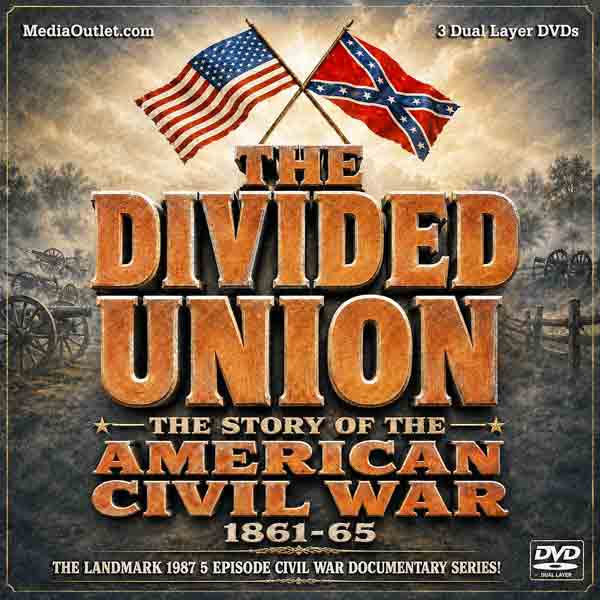
May 12, 1865: The American Civil War (The
Civil War, The War Between The States): Naval Warfare Of The
American Civil War (Naval Battles Of The American Civil War): The
Trans-Mississippi Theater Of The American Civil War: The Battle Of
Palmito Ranch (The Battle Of Palmito Hill): -- The last major land
action to take place during the Civil War begins, ultimately
resulting in a Confederate victory, as Union Colonel Theodore H.
Barrett, newly assigned to command the all-black 62nd Regiment of
U.S. Colored Troops (also known as the 1st Missouri Colored
Infantry Regiment), and never having been involved in combat,
broke an unofficial truce that Union and Confederate forces in
southern Texas had been observing since the beginning of 1865 and,
for reasons that can only be surmised, ordered an attack on a
Confederate camp near Fort Brown, Texas. Also known as The Battle
Of Palmito Hill, The Battle of Palmito Ranch is considered by some
criteria as the final battle of the American Civil War; the battle
took place more than a month after the general surrender of
Confederate forces to Union forces at Appomattox Court House,
which information had since been communicated to both commanders
at Palmito, and since in the intervening weeks the Confederacy had
collapsed entirely, The Battle Of Palmito Ranch can also be
classified as a postwar action. It was fought May 12 and 13, 1865,
on the banks of the Rio Grande east of Brownsville, Texas, and a
few miles from the seaport of Los Brazos de Santiago, at the
southern tip of Texas. The Union attackers captured a few
prisoners, but the following day the attack was repulsed near
Palmito Ranch by Colonel John Salmon Ford, as Union forces were
surprised by artillery said to have been supplied to the
Confederates by the French Army garrison occupying the up-river
Mexican town of Matamoros. Casualty estimates are not dependable,
but it is believed that Union Private John J. Williams of the
white 34th Indiana Infantry Regiment was the last man killed
during the engagement, arguably making him the last man killed in
The American Civil War. On Sale @ 15% Off Discount Till Midnight
PT!
https://store.earthstation1.com/the-divided-union-american-civil-war-tv-series-3-dual-layer-dvd3.html
Today's
EarthStation1.com 15% Off Commemorative Memorial Title: The Golden
Age Of Second Avenue DVD, MP4 Video Download, Flash Drive
Today, May 12, 2026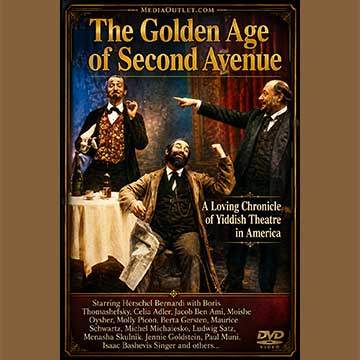
May 12, 1868: #BOTD: #HBD! Boris
Thomashefsky (Russian: Boris Pinkhasovich Tomashevsky, sometimes
written Thomashevsky, Thomaschevsky, etc.; Yiddish: Boris
Tomashevsky), Ukrainian-American Jewish singer and actor who
became one of the biggest stars in Yiddish theater (d. July 9,
1939) is #born Boruch-Aharon Thomashefsky in Osytnyazhka (Yiddish:
Ositnyashke), a village in the Chyhyryn county of the Kiev
Governorate of the Russian Empire (today in the Kirovohrad Oblast,
Ukraine). He grew up in the nearby town of Kamyanka (today in the
Cherkasy Oblast, Ukraine), until, at the age of 11, he left for
Berdychiv where he trained as a meshoyrer (choir singer) in the
renowned synagogue choir of cantor Nisan Belzer. In 1881, he
emigrated with his family to the United States, and just a year
later, while still a teenager, he was largely responsible for the
first performance of Yiddish theater in New York City, in what was
to become the Yiddish Theater District. He has been credited as
the pioneer of Borscht Belt entertainment. Although Thomashefsky
left Imperial Russia at a time when Yiddish theater was still
thriving there (it was banned in September 1883), he had never
seen it performed prior to the 1882 performance he brought
together in New York. Thomashefsky, who was earning some money by
singing on Saturdays at the Henry Street Synagogue on the Lower
East Side, was also working as a cigarette maker in a sweatshop,
where he first heard songs from the Yiddish theater, sung by some
of his fellow workers. Thomashefsky managed to convince a local
tavern owner to invest in bringing over some performers. The first
performance was Abraham Goldfaden's Yiddish operetta ?? ????? (The
Witch). The performance was a mild disaster: pious and prosperous
"uptown" German Jews opposed to the Yiddish theater did
a great deal to sabotage it. His performing career was launched in
part due to an instance of this sabotage-bribing the soubrette to
fake a sore throat: Thomashefsky went on in her place. Shortly
afterward, the teenage Thomashefsky was the pioneer of taking
Yiddish theater "on the road" in the United States,
performing Goldfaden's plays in cities such as Philadelphia,
Washington, D.C., Baltimore, Pittsburgh, Boston and Chicago, all
in the 1880s; for much of the 1880s, Chicago was his base. After
Yiddish theater was banned in Russia, his tours came to include
such prominent actors as Siegmund Mogulesko, David Kessler, and
Jacob Adler, with new plays by playwrights such as Moses Ha-Levi
Horowitz. In 1887, playing in Baltimore, he met 14-year-old Bessie
Baumfeld-Kaufman, when she came backstage to meet the beautiful
young "actress" she had seen on stage, only to discover
that "she" was Boris. Bessie soon ran away from home to
join the company, and eventually took over the ingenue roles, as
Boris moved on to romantic male leads. They married in 1891. In
1891, with Mogulesko, Kessler, and Adler all engaged in starting
the Union Theater, Moishe Finkel brought the still relatively
unknown Thomashefsky back to New York to star at his National
Theater, where Thomashefsky became enough of a success in Moses
Halevy Horowitz's operetta David ben Jesse as to force the Union
Theater temporarily to abandon its highbrow programming and
compete head on. After Adler recruited Jacob Gordin as a
playwright and found a way to draw the masses to serious theater
with Gordin's The Yiddish King Lear, and then turned to
Shakespeare's Othello, Thomashefsky decided to show that he could
compete on that ground as well, and responded with the first
Yiddish production of Shakespeare's Hamlet, in which, by all
reports, he acquitted himself excellently. His production of
Hamlet was more than just a direct translation; the story was also
adapted to make it more accessible to a devout European Jewish
audience. At the start of the play, young Hamlet has been away at
Rabbinical college, and his uncle has seduced the Queen Mother
away from King Hamlet, breaking the old man's heart. There are
sectarian jokes regarding communication with angels. Claudius
spreads a rumor that Prince Hamlet has succumbed to nihilism while
away, but his scheme is discovered and the traitor is sent to
Siberia in his nephew's stead. The play ends early, with Hamlet
ceremonially marrying Ophelia at her funeral then dying of a
broken heart. These types of edits were not uncommon in the
Yiddish-language theatre scene. Some critics view it as a step
away from immigrant assimilation, others as one step further
towards common ground between the new residents and their American
neighbors. These productions ushered in what is generally seen as
the first great age of Yiddish theater, centered in New York and
lasting approximately until a new wave of Jewish immigration in
1905-08 once again resulted in a vogue for broad comedy,
vaudeville and light operettas, which the Thomashefskys embraced
wholeheartedly, especially in performing Leon Kobrin's plays about
immigrant life. Other notable Thomashefsky productions included
Yiddish versions of Uncle Tom's Cabin, Goethe's Faust and,
unlikely as it may seem, Wagner's Parsifal. According to the
Jewish Virtual Library, in an adaptation of Hamlet called Der
Yeshiva Bokher (The Yeshiva Student), "a wicked uncle smears
rabbinic candidate's reputation by calling him a nihilist and the
young man dies of a broken heart." (They don't say whether
this was the production that went head-to-head with the
Adler/Kessler Othello.) By 1910, Thomashefsky owned a 12-room home
on Bedford Avenue in Brooklyn, plus a bungalow by the sea, and 20
acres (81,000 m2) in Hunter, New York, which included an open-air
theater, Thomashefsky's Paradise Gardens. Each of his three sons
had an Arabian horse. However, in 1915, Thomashefsky filed for
bankruptcy, listing assets of 21,900 bucks and debts of 76,297.65
bucks. In 1935, late in his career, Thomashefsky was an
actor/singer in Henry Lynn's Yiddish film Bar Mitzvah, in which he
played a melodramatic role with gusto and co-produced the film. He
sang, Erlekh Zayn (Be Virtuous), a song from a 1924 Yiddish play,
Bar Mitzvah. With his wife, actress Bessie Thomashefsky, he had
three sons, as well a daughter who died when she was six years
old. The third son, Theodore, changed his name to Ted Thomas and
became a stage manager. One of Ted Thomas's sons is conductor
Michael Tilson Thomas. The first son, Harry, went on to direct the
film The Yiddish King Lear (1935), under the auspices of the
Federal Theatre Project, and later moved with his mother to Los
Angeles. The second son, Mickey, had affairs with two women at the
same time, which led to a dramatic murder-attempt/suicide in 1931,
reminiscent of his aunt Emma Thomashefsky Finkel's notorious 1904
affair. Both Mickey and his Aunt Emma were left paralyzed by the
attempted murders by jealous mates and both later died of
complications related to their wounds; Emma, many years later, in
1929, and Mickey, five years after in 1936. Boris Thomashefsky
carried on a long-term affair with Yiddish actress Regina
Zuckerberg, an Austrian-born actress twenty years younger than
Bessie. This caused Boris and Bessie to separate. Both went on to
have successful but separate careers. However, Boris became a
pauper in the 1930s. Both Thomashefskys did much to shape the
world of modern theatre from the follies to Broadway and gave a
start to many actors, composers and producers who went on to start
and own theaters and movie studios. Even the Gershwin brothers had
their start with the Thomashefkys. They were also prominent in
addressing controversial social issues of the day and in teaching
the Greenhorns how to be Americans. They not only founded theaters
and production companies, but had publishing houses and many other
successful business adventures. Boris Thomashefsky even founded
and funded a Jewish Army which he sent to Israel and was named
after him. The unit later became a unit in the British Army. Boris
Thomashefsky died of unspecified causes in New York City, aged 71.
Thomashefsky is buried with his wife, who, although separated from
him by 1911, never divorced him, in the Yiddish theater section of
the Mount Hebron Cemetery, Flushing, Queens, New York. In the
third Marx Brothers movie, Monkey Business, Groucho Marx (in
defending his right to hide in a gangster's moll's closet)
exclaims, "That's what they said to Thomas Edison, mighty
inventor, Thomas Lindbergh, mighty flyer, and Thomashefsky,
'mighty like a rose'!" Tribute was also paid in Mel Brooks'
stage and film musicals based on his 1968 film The Producers, when
Max Bialystock attributes his acumen as a Broadway producer to the
tutelage of "the great Boris Thomashefsky" in the song
"The King of Broadway". In 2011, Shuler Hensley
portrayed Boris Thomashefsky in The Thomashefskys: Music and
Memories of a Life in the Yiddish Theater, a concert stage show
celebrating the Thomashefskys and the music of American Yiddish
theatre hosted by their grandson the conductor Michael Tilson
Thomas. The show aired on the PBS series Great Performances in
2012. On Sale @ 15% Off Discount Till Midnight PT!
https://store.earthstation1.com/the-golden-age-of-second-ave-yiddish-theatre-in-america-dvd.html
Today's
EarthStation1.com 15% Off Commemorative Memorial Title: The Green
Berets & Special Forces Documentary Set 2 MP4s Or 2 DVDs
Today, May 12, 2026
May 12, 1890: #BOTD: Kurt Student, German
general and pilot, general in the Luftwaffe during World War II,
early pioneer of airborne forces who was in overall command of
developing a paratrooper force to be known as the Fallschirmjager,
and as the most senior member of the Fallschirmjager, commanded it
throughout the war, leader of the first major airborne attack in
history, the Battle for The Hague in May 1940, commander of the
Fallschirmjager in its last major and most storied airborne
operation, the invasion of Crete in May 1941, a success despite
German losses which led the Allies to hasten the training and
development of their own airborne units (d. July 1, 1978) is #born
Kurt Arthur Benno Student in Birkholz, German Empire (now Borow,
Poland). In 1947, Student was tried and convicted of war crimes
for the mistreatment and murder of prisoners of war by his men in
Crete. Student was also responsible for a wave of reprisal
massacres committed against Cretan civilians in 1941 but avoided
harsh punishment. Kurt Student died of natural causes in Lemgo,
West Germany, aged 88, the last surviving Luftwaffe Generaloberst.
He is buried at Waldfriedhof Obernberg in Bad Salzuflen,
Westfalen, Germany. On Sale @ 15% Off Discount Till Midnight PT!
https://store.earthstation1.com/the-green-berets-amp-the-story-of-special-forces-dvd-mp4-us4.html
Today's
EarthStation1.com 15% Off Commemorative Memorial Title: The
Historical View A Legacy In Pictures JPG Image Set CD Download USB
Today, May 12, 2026
May 12, 1895: #BOTD: #HBD! Jiddu
Krishnamurti, Indian-American philosopher, speaker and writer (d.
February 17m 1986) is #born in Madanapalle, Madras Presidency,
British India. In his early life he was groomed to be the new
World Teacher but later rejected this mantle and withdrew from the
Theosophy organization behind it. His subject matter included
psychological revolution, the nature of mind, meditation, inquiry,
human relationships, and bringing about radical change in society.
He constantly stressed the need for a revolution in the psyche of
every human being and emphasised that such revolution cannot be
brought about by any external entity, be it religious, political,
or social. Krishnamurti was born in India. In early adolescence he
had a chance encounter with prominent occultist and theosophist
Charles Webster Leadbeater in the grounds of the Theosophical
Society headquarters at Adyar in Madras. He was subsequently
raised under the tutelage of Annie Besant and Leadbeater, leaders
of the Society at the time, who believed him to be a 'vehicle' for
an expected World Teacher. As a young man, he disavowed this idea
and dissolved the Order of the Star in the East, an organisation
that had been established to support it. Krishnamurti said he had
no allegiance to any nationality, caste, religion, or philosophy,
and spent the rest of his life travelling the world, speaking to
large and small groups and individuals. He wrote many books, among
them The First and Last Freedom, The Only Revolution, and
Krishnamurti's Notebook. Many of his talks and discussions have
been published. His last public talk was in Madras, India, in
January 1986, a month before his death at his home in Ojai,
California. His supporters, working through non-profit foundations
in India, Great Britain and the United States, oversee several
independent schools based on his views on education. They continue
to transcribe and distribute his thousands of talks, group and
individual discussions, and writings by use of a variety of media
formats and languages. Krishnamurti was unrelated to his
contemporary U. G. Krishnamurti (1918-2007), although the two men
had a number of meetings. Krishnamurti died of pancreatic cancer
at the age of 90 at 10 minutes past midnight in his California
home in Ojai, California. The announcement of KFT (Krishnamurti
Foundation Trust) refers to the course of his health condition
until the moment of death. The first signs came almost nine months
before his death, when he felt very tired. In October 1985, he
went from the Krishnamurti foundation's Brockwood Park School in
Bramdean, Alresford, Hampshire, South East England to India, and
after that, he suffered from exhaustion, fevers, and lost weight.
Krishnamurti decided to go back to Ojai (10 January 1986) after
his last talks in Madras, which necessitated a 24-hour flight.
Once he arrived at Ojai he underwent medical tests that revealed
he was suffering from pancreatic cancer. The cancer was
untreatable, either surgically or otherwise, so Krishnamurti
decided to go back to his home at Ojai, where he spent his last
days. Friends and professionals nursed him. His mind was clear
until the last moment. In accordance with his wishes, no memorial
service was conducted. His ashes were divided into three parts:
for Ojai, for India and for England (likely Brockwood Park School
in Bramdean). In India they were immersed in River Ganga in
Varanasi, Gangotri, and in the ocean by the beach of the Adyar
River at the Bay of Bengal at the Adyar estuary. On Sale @ 15% Off
Discount Till Midnight PT!
https://store.earthstation1.com/the-historical-view-a-legacy-in-pictures-jpg-photo-cd.html
Today's
EarthStation1.com 15% Off Commemorative Memorial Title: Katharine
Hepburn: All About Me Personal Reflections DVD, MP4, USB
Today, May 12, 2026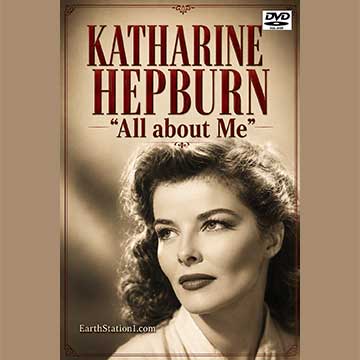
May 12, 1907: #BOTD: #HBD! Katharine
Hepburn, American leading lady, film, stage and television
actress, cultural icon and beauty, recipient of four Academy
Awards - a record for any performer - for Best Actress, who
epitomized the "modern woman" in the 20th-century United
States and is remembered as an important cultural figure (d. June
29, 2003) is #born Katharine Houghton Hepburn in Hartford,
Connecticut. Known for her fierce independence and spirited
personality, Hepburn worked in Hollywood for more than 60 years,
appearing in a range of genres, from screwball comedy to literary
drama. In 1999, Hepburn was named by the American Film Institute
as the greatest female star of Classic Hollywood Cinema. Raised in
Connecticut by wealthy, progressive parents, Hepburn began to act
while studying at Bryn Mawr College. After four years in the
theatre, favorable reviews of her work on Broadway brought her to
the attention of Hollywood. Her early years in the film industry
were marked with success, including an Academy Award for her third
picture, Morning Glory (1933), but this was followed by a series
of commercial failures that led her to be labeled "box office
poison" in 1938. Hepburn masterminded her own comeback,
buying out her contract with RKO Radio Pictures and acquiring the
film rights to The Philadelphia Story, which she sold on the
condition that she be the star. In the 1940s, she was contracted
to Metro-Goldwyn-Mayer, where her career focused on an alliance
with Spencer Tracy. The screen partnership spanned 25 years and
produced nine movies. Spencer Tracy was the most significant
relationship of Hepburn's life. In her autobiography she wrote,
"It was a unique feeling that I had for [Tracy]. I would have
done anything for him.". Lauren Bacall, a close friend, later
wrote of how "blindingly" in love Hepburn was with the
actor. The relationship has subsequently received much publicity,
and it is often cited as one of Hollywood's legendary love
affairs. Tracy remained married throughout their relationship;
although he and his wife Louise had been living separate lives
since the 1930s, there was never an official split and neither
party pursued a divorce. Hepburn did not interfere, and never
fought for marriage. Hepburn challenged herself in the latter half
of her life, as she regularly appeared in Shakespearean stage
productions and tackled a range of literary roles. She found a
niche playing middle-aged spinsters, such as in The African Queen
(1951), a persona the public embraced. Three more Oscars came for
her work in Guess Who's Coming to Dinner (1967), The Lion in
Winter (1968), and On Golden Pond (1981). In the 1970s, she began
appearing in television films, which became the focus of her
career in later life. She remained active into old age, making her
final screen appearance in 1994 at the age of 87. After a period
of inactivity and ill health, Hepburn died of cardiac arrest at
the age of 96 at the Hepburn family home in Fenwick, Connecticut.
She is buried in Cedar Hill Cemetery in Hartford, Connecticut.
Hepburn requested that there be no memorial service. Hepburn's
death received considerable public attention. Many tributes were
held on television, and newspapers and magazines dedicated issues
to the actress. American president George W. Bush said Hepburn
"will be remembered as one of the nation's artistic
treasures". In honor of her extensive theatre work, the
lights of Broadway were dimmed for the evening of July 1, 2003. In
2004, in accordance with Hepburn's wishes, her belongings were put
up for auction with Sotheby's in New York City. The event garnered
5.8M USD, which Hepburn willed to her family. Hepburn famously
shunned the Hollywood publicity machine and refused to conform to
society's expectations of women. She was outspoken, assertive,
athletic, and wore trousers before it was fashionable for women to
do so. With her unconventional lifestyle and the independent
characters she brought to the screen, Hepburn epitomized the
"modern woman" in the 20th-century United States and is
remembered as an important cultural figure. On Sale @ 15% Off
Discount Till Midnight PT!
https://store.earthstation1.com/katharine-hepburn-all-about-me-dvd-mp4-us4.html
Today's
EarthStation1.com 15% Off Commemorative Memorial Title: The
Complete Kennedy-Nixon Debates All 4 + Bonus Doc DVD MP4 USB Drive
Today, May 12, 2026
May 12, 1914: #BOTD: #HBD! Howard K.
Smith, American broadcast journalist, radio reporter, television
anchorman, political commentator, antifascist and film actor (d.
2002) is #born Howard Kingsbury Smith in Ferriday, Louisiana to
Howard K. Smith, a nightwatchman descended from a poor
"gentleman-farming" family of Lettsworth, Pointe Coupee
Parish (north of Baton Rouge), and the former Minnie Gates, the
daughter of a Cajun riverboat pilot. He was one of the original
members of the team of war correspondents known as the Murrow
Boys, the CBS radio broadcast journalists most closely associated
with Edward R. Murrow during his time at the network, most notably
in the years before and during World War II, who achieved
nationwide fame, and inadvertently became early examples of
"celebrity journalism" in the days of radio and early
television news. Smith worked his way through Tulane University in
New Orleans, studying German and journalism. After his graduation
in 1936, with both Bachelor of Arts degrees, he signed on as a
deckhand with a ship bound for Germany, where he briefly studied
at Heidelberg University. In 1936, he spent a year as a reporter
in New Orleans before securing a Rhodes Scholarship to Merton
College, Oxford, from which he graduated in 1939. Smith became
active in student politics, mostly protesting Prime Minister
Neville Chamberlain's seemingly soft attitude toward Nazism. While
at Oxford, he was the first American to chair the Oxford
University Labour Club, founded in 1919 to promote democratic
socialism and is today the home of the Labour Party and of social
democracy at Oxford University. Upon graduating, Smith worked for
the New Orleans Item, with United Press in London, and with The
New York Times. In January 1940, Smith was sent to Berlin, where
he joined the Columbia Broadcasting System under Edward R. Murrow.
He visited Hitler's mountain retreat at Berchtesgaden and
interviewed many leading Nazis, including Hitler himself,
Schutzstaffel or "SS" leader Heinrich Himmler and
Propaganda Minister Joseph Goebbels. When Smith refused to include
Nazi propaganda in his reports, the Gestapo seized his notebooks
and expelled him from the country. He left for Switzerland on
December 6, 1941, the day before the Japanese attack on Pearl
Harbor, Hawaii. He was one of the last American reporters to leave
Berlin before Germany and the United States went to war. His 1942
book, Last Train from Berlin: An Eye-Witness Account of Germany at
War describes his observations from Berlin in the year after the
departure of Berlin Diary author William L. Shirer. Last Train
from Berlin became an American best-seller and was reprinted in
2001, shortly before Smith's death. Unable to leave Switzerland,
where he and his young wife spent most of the war, Smith reported
whatever the Swiss government would permit. After the liberation
of France, he began reporting on Germany and central Europe from
Berne. By the winter of 1944-1945, he began sending vivid radio
accounts of the German counter-attack in the Ardennes known as the
Battle Of The Bulge, and he accompanied Allied forces across the
Rhine River and into Berlin. Smith became a significant member of
the "Murrow Boys" that made CBS the dominant broadcast
news organization of the era. In May 1945, he returned to Berlin
to recap the German surrender. In 1946, Smith went to London for
CBS with the title of chief European correspondent. In 1947, he
made a long broadcasting tour of most of the nations of Europe,
including behind the Iron Curtain. In 1949, Knopf published his
The State of Europe, a 408-page country-by-country survey of
Europe that drew on these experiences and that argued "both
the American and the Russian policies are mistaken"; he
advocated more "social reform" for Western Europe and
more "political liberty" for Eastern Europe. Despite
these criticisms of Soviet policies, Smith was one of 151 alleged
Communist sympathizers named in the Red Channels report issued in
June 1950 at the beginning of the Red Scare, effectively placing
him on the Hollywood blacklist. In 1959, Smith hosted a 21-week
public affairs series entitled Behind the News with Howard K.
Smith. Topics included Nikita Khrushchev (a two-parter), the St.
Lawrence Seaway, Fidel Castro, and unemployment in distressed
areas. In 1960, having established residence earlier in Bethesda,
Maryland, Smith chaired the first-ever televised presidential
debates, held between U.S. Senator John F. Kennedy of
Massachusetts and Vice President Richard M. Nixon. In late 1961,
Smith left his job at CBS when a dispute erupted over a
documentary called Who Speaks for Birmingham?. This in-depth
investigation concerned the battle between civil rights forces and
the police of Birmingham, Alabama. Smith, an advocate of
desegregation, concluded his commentary at the end of the program
by recalling the admonition commonly attributed to Edmund
Burke-"All that is necessary for evil to triumph is for good
men to do nothing." Smith was told to remove the Burke quote
from the end of the broadcast. Network president and founder
William S. Paley declined to support Smith over the matter, and
Smith promptly left the network after twenty years of service.
Smith declared that his hatred of discrimination stemmed from
living in the acially segregated American South and from watching
the Nazis in Europe during the world war. Smith moved to ABC at a
time its news division was a distant third among the Big Three
networks. After the 1962 mid-term elections, Smith presented a
documentary entitled, "The Political Obituary of Richard
Nixon" as part of his Howard K. Smith: News and Comment
series (1962-1963). Smith referred to Nixon's "last press
conference" after his disastrous losing campaign against
Democrat Edmund G. "Pat" Brown, Sr., for governor of
California. In that exchange, the former vice president famously
told reporters that they would not "have Nixon to kick around
any more." Smith included in the broadcast an interview with
Nixon's longstanding nemesis Alger Hiss, a convicted Cold War
perjurer. Howard K. Smith: News and Comment aired in the 10:30
Eastern slot on Sundays, opposite CBS's long-running quiz program
What's My Line? hosted by John Charles Daly, who had been the
first-ever ABC news anchor. ABC stood by Smith on the Nixon
"obituary", but sponsors dried up for the program
thereafter. It was revived in the 1963-1964 season as simply ABC
News Reports. Smith was a frequent interviewer with Bob Clark on
the ABC Sunday news program, Issues and Answers, which began in
1960 and was subsequently revamped and renamed in 1981 as This
Week with David Brinkley. On June 5, 1968, Smith and fellow
newsman Bill Lawrence were anchoring coverage of the California
presidential primary that had stretched to 3 am. New York time. As
the closing credits for the special were airing, word came in that
United States Senator Robert F. Kennedy of New York had been shot
at the Ambassador Hotel in Los Angeles. ABC simply showed a wide
shot of the chaotic newsroom for several minutes until Smith was
able to confirm the initial story and go back on the air with a
special report. He and Lawrence continued at their anchor desks
for several more hours for reports of Kennedy's condition. In the
summer of 1968, Smith moderated a series of debates on ABC between
conservative journalist William F. Buckley Jr. and liberal author
Gore Vidal. In 1969, the veteran reporter became the co-anchor of
the ABC Evening News, first with Frank Reynolds, then the
following year with another CBS alumnus, Harry Reasoner. He began
making increasingly conservative commentaries, in particular a
hard-line stance in support of the Vietnam War. He contrasted
United States President Lyndon B. Johnson's decisive stance in
Vietnam with the international failure to take preemptive action
against Hitler. During this period, his son, future ABC newsman,
Jack Smith (April 25, 1945 - April 7, 2004), was serving with the
U.S. Army 7th Cavalry Regiment in South Vietnam and fought at the
Battle of Ia Drang. These commentaries endeared him to President
Nixon, who rewarded him with a rare, hour-long, one-on-one
interview in 1971, at the height of the administration's animus
against major newspapers, CBS, and NBC, despite Smith's having
broadcast his "political obituary" only nine years
earlier. ABC News commentator Howard K. Smith with Richard Nixon
in 1971. During the 1972 presidential campaign, a letter was
published that Smith had written to Democratic United States
Senator Edmund S. Muskie of Maine, indicating Smith's full support
for Muskie. The endorsement was written on stationery with ABC's
letterhead. Nothing ever came of this controversy, however, and
Smith kept his job. Notwithstanding his past temporary friendly
relations with Nixon (who defeated U.S. United States Senator
George S. McGovern of South Dakota for re-election), Smith became
the first national television commentator to call for Nixon's
resignation over Watergate. Smith remained as co-anchor at ABC
until 1975, after which Reasoner anchored solo until Barbara
Walters joined the broadcast a year later. Smith continued as an
analyst until 1979; he left the network nearing full retirement,
and as the Roone Arledge era was beginning at ABC News. Sources
say that Smith was embittered over the reduction in time allowed
for his commentaries and hence resigned after he criticized the
revamped World News Tonight format as a "Punch and Judy
show." Among honors which Smith received over the years were
DuPont Awards in 1955 and 1963, a Sigma Delta Chi Award for radio
journalism in 1957, and an award from the American Jewish Congress
in 1960. In 1962 he received the Paul White Award from the Radio
Television Digital News Association. Smith also appeared in a
number of films, often as himself; The Best Man (1964), The
Candidate (1972), The President's Plane Is Missing (1973, a
made-for-television production of the Robert J. Serling novel of
the same name), Nashville (1975), Network (1976), The Pink Panther
Strikes Again (1976), Close Encounters of the Third Kind (1977),
The Pursuit of D. B. Cooper (1981), The Best Little Whorehouse in
Texas (1982), "The Odd Candidate" (1974) episode of the
television series The Odd Couple (playing himself), the "Kill
Oscar" episode (1977) of The Bionic Woman (playing himself
anchoring an ABC newscast), and both V (1983) and the subsequent
1984 television series. He appeared as the Narrator in the 1987
film Escape From Sobibor. Along with Last Train from Berlin, he
wrote three other books, The Population Explosion (1960), the
children's book Washington, D.C.: The Story of our Nation's
Capital (1967), and a memoir Events Leading Up to My Death: The
Life of a Twentieth-Century Reporter (1996). Smith's son, Jack, as
an ABC correspondent received Peabody and Emmy awards for his
coverage of technology; he was 58 when he died in 2004 of
pancreatic cancer in Marin County, Calif. Smith also had a
daughter, Catherine H. Smith of Los Angeles, by his March 1942
marriage to the former Benedicte "Bennie" Traberg
(September 25, 1921 - October 29, 2008), a journalist originally
from Denmark whom Smith called the most impressive person he had
ever known, "far above presidents and generals." There
were three grandchildren. Catherine Smith, who wrote her mother's
obituary, quoted from Smith's 1996 memoirs Events Leading Up to My
Death, that their relationship "was born in an atmosphere of
acute crisis." With World War II heating up, recalled
Catherine Smith, and both of them heading out of the German
capital, they decided to marry just four days after their first
date. Her young age required her return to Nazi-occupied Denmark
for parental approval and the Danish queen's intervention to
obtain travelling papers, but the couple reunited successfully
three months later in Berne, Switzerland." Mrs. Bennie Smith
managed her husband's career, handled the finances and
investments, and helped with the processing of his publications.
Catherine Smith noted that her mother was the one most responsible
for the development of his patrician demeanor. "She was a
formidable presence at his side and major force behind his
success. She edited all his books and articles, and was his agent,
negotiating all his broadcasting and other contracts. She arranged
every aspect of what, in later years, became a very lucrative
speaking career. When my parents traveled on the lecture circuit,
she once laughingly told a Lansing, Mich. paper...: 'My husband
never knows where his trips will take him .... It's not until we
get ready to board the plane that he'll inquire 'Where are we
going?' and then I will tell him.'" The Smiths lived at their
Potomac River home in Bethesda, Md. from 1958 until his February
15, 2002 death at the age of 87 from pneumonia, after which Mrs.
Smith relocated to a condominium on Marco Island, Fla. She died at
87 of complications from hydrocephalus. The Smiths are interred at
historic Oak Hill Cemetery in the Georgetown section of
Washington, D.C. On Sale @ 15% Off Discount Till Midnight PT!
https://store.earthstation1.com/the-great-kennedynixon-debate-dvd.html
Today's
EarthStation1.com 15% Off Commemorative Memorial Title: Frontiers
Of Flight Aviation History TV Series DVD, MP4, USB Drive
Today, May 12, 2026
May 12, 1926: Polar Exploration: North
Pole Exploration: Aviation: The History Of Aviation: Lighter Than
Air Aviation (Lighter-Than-Air-Aviation): The History Of
Ballooning: The History Of Airships (The History Of Dirigibles,
The History Of Dirigible Balloons): The History Of Semi-Rigid
Airships: The Amundsen-Ellsworth 1926 Transpolar Flight (The Norge
Transpolar Flight Transpolar Flight): The Norge (Italian:
"Norway"): -- The Italian-built semi-rigid airship Norge
carries out the first verified trip of any kind to the North Pole
when it overflies it. The Norge was also the first aircraft to fly
over the polar ice cap between Europe and America. The expedition
was the brainchild of polar explorer and expedition leader Roald
Amundsen; the airship's designer and pilot Umberto Nobile; and
American explorer Lincoln Ellsworth, who along with the Aero Club
of Norway, financed the trip which was known as the
Amundsen-Ellsworth 1926 Transpolar Flight. In 1925, Amundsen
telegraphed Nobile asking to meet him at Oslo, where he proposed
an airship trip across the Arctic. With a contract in place,
Nobile modified the already completed airship, at that time named
the N-1, for flight in arctic weather. As the expedition was being
financed by the Aero Club of Norway, the refitted N-1 was
christened the Norge (English: Norway). On March 29, 1926 at a
ceremony at Ciampino aerodrome the Norge was handed over to the
Aero Club of Norway. The flight north was due to leave Rome on
April 6 but was delayed due to strong winds and departed at 09:25
on April 10. The ship arrived at RNAS Pulham Airship Station in
England at 15:20; because of the bad weather was not moored in the
hangar until 18:30. Delayed again by weather, the Norge left
Pulham for Oslo at 11:45 on April 12. At 01:00 on April 15, 1926,
the Norge left Ekeberg in Oslo for Gatchina near Leningrad; after
a 17-hour flight, the airship arrived at 19:30, delayed by dense
fog along the way. Following the arrival at Gatchina, Nobile
announced that the Norge would remain in the airship shed for a
week for engine overhaul and maintenance; this included the
addition of collapsible rubber boats for emergency use. Although
scheduled to leave Gatchina as soon as the weather allowed after
April 24, the departure was delayed another week as the mooring
mast at King's Bay, Spitsbergen had not yet been completed due to
adverse weather. Although Nobile was anxious to leave for
Spitsbergen even if the mast and shed were not completed as he was
concerned about the weather, the departure from Gatchina was
postponed once again. The Norge finally left Gatchina at 09:40 on
May 5 to proceed to Vadso in northern Norway, where the airship
mast is still standing today. The expedition then crossed the
Barents Sea to reach King's Bay at Ny-Alesund, Svalbard. There
Nobile met Richard Evelyn Byrd preparing his Fokker Trimotor for
his North Pole attempt. Nobile explained the Norge trip was to
observe the uncharted sea between the Pole and Alaska where some
believed land was; at the time he thought Robert Edwin Peary had
already reached the pole. This would be the last stop before
crossing the pole. The dirigible left Ny-Alesund for the final
stretch across the polar ice on May 11 at 9:55. The 16-man
expedition included Amundsen, the expedition leader and navigator;
Nobile, the dirigible's designer and pilot; Lincoln Ellsworth,
American outdoorsman and expedition sponsor, and polar explorer
Oscar Wisting who served as helmsman. Other crew members were 1st
Lt. Hjalmar Riiser-Larsen, navigator; 1st Lt. Emil Horgen,
elevatorman; Capt. Birger Gottwaldt, radio expert, Dr Finn
Malmgren of Uppsala University, meteorologist; Fredrik Ramm,
journalist; Frithjof Storm-Johnsen, radioman; Flying Lt. Oscar
Omdal, flight engineer; Natale Cecioni, chief mechanic; Renato
Alessandrini, rigger; Ettore Arduino, Attilio Caratti and Vincenzo
Pomella, mechanics. Nobile's little dog, Titina, also came aboard
as mascot. On May 12 at 01:25 (GMT) the Norge reached the North
Pole, at which point the Norwegian, American and Italian flags
were dropped from the airship onto the ice. Relations between
Amundsen and Nobile, which had been lukewarm at best, were
aggravated by the freezing and noisy conditions in the dirigible's
cramped, unheated control car, and deteriorated further when
Amundsen saw that the Italian flag dropped by Nobile was larger
than either of the others. Amundsen later recalled with scorn that
Nobile, had tossed several flags and banners overboard and the
Norge had become "a circus wagon of the skies", an
occurrence Nobile claimed Amundsen had greatly exaggerated. After
crossing the pole, the airship's propellers became encrusted with
ice to such an extent that pieces breaking off were flung against
the outer cover, causing several rips and tears in the fabric.
According to Nobile, "The ice forming on the propellers as we
went through the fog, and hurled against the underside of the bag,
had pretty well scarred up the fabric covering the keel, though it
had not opened up the gas bags or caused any hydrogen loss. We had
used up all our cement in repairing the fabric..." On May 14,
the Norge reached the Inupiat village of Teller, Alaska, where in
view of worsening weather, the decision was made to land there
rather than continue on to Nome, approximately 70 miles away. The
airship was reportedly damaged somehow during the landing and was
dismantled and shipped back to Italy. The three previous claims to
have arrived at the North Pole-by Frederick Cook in 1908, Robert
Peary in 1909, and Richard E. Byrd in 1926 (just a few days before
the Norge)-are all disputed as being either of dubious accuracy or
outright fraud. Some of those disputing these earlier claims
therefore consider the crew of the Norge to be the first verified
explorers to have reached the North Pole. On Sale @ 15% Off
Discount Till Midnight PT!
https://store.earthstation1.com/frontiers-of-flight-aviation-history-tv-series-dvd-mp4-download-us4.html
Today's
EarthStation1.com 15% Off Commemorative Memorial Title: After The
Fox (1966) Peter Sellers Victor Mature DVD MP4 USB Drive
Today, May 12, 2026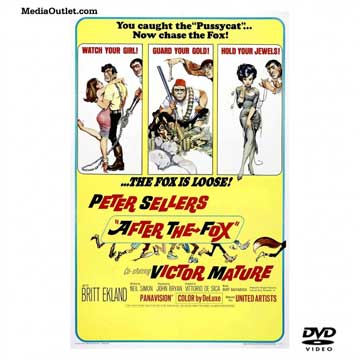
May 12, 1928: #BOTD: #HBD! Burt
Bacharach, American singer, songwriter, composer, pianist and
record producer (d. February 8, 2023) is #born Burt Freeman
Bacharach in Kansas City, Missouri into the Jewish family of Irma
M. (nee Freeman) and Mark Bertram "Bert" Bacharach, a
well-known syndicated newspaper columnist. He grew up in the Kew
Gardens section of New York City Bacharach composed hundreds of
pop songs from the late 1950s through the 1980s, many in
collaboration with lyricist Hal David. A six-time Grammy Award
winner and three-time Academy Award winner, Bacharach's songs have
been recorded by more than 1,000 different artists. As of 2014, he
had written 73 US and 52 UK Top 40 hits. He is considered one of
the most important composers of 20th-century popular music. His
music is characterized by unusual chord progressions, influenced
by his background in jazz harmony, and uncommon selections of
instruments for small orchestras. Most of Bacharach's and David's
hits were written specifically for and performed by Dionne
Warwick, but earlier associations (from 1957 to 1963) saw the
composing duo work with Marty Robbins, Perry Como, Gene McDaniels,
and Jerry Butler. Following the initial success of these
collaborations, Bacharach went on to write hits for Gene Pitney,
Cilla Black, Dusty Springfield, Jackie DeShannon, Bobbie Gentry,
Tom Jones, Herb Alpert, B. J. Thomas, the Carpenters, among
numerous other artists. He arranged, conducted, and produced much
of his recorded output. Songs that he co-wrote which have topped
the Billboard Hot 100 include "This Guy's in Love with You"
(1968), "Raindrops Keep Fallin' on My Head" (1969),
"(They Long to Be) Close to You" (1970), "Arthur's
Theme (Best That You Can Do)" (1981), and "That's What
Friends Are For" (1986). A significant figure in easy
listening, Bacharach is described by writer William Farina as "a
composer whose venerable name can be linked with just about every
other prominent musical artist of his era." In later years,
his songs were newly appropriated for the soundtracks of major
feature films, by which time "tributes, compilations, and
revivals were to be found everywhere". He has been noted for
his influence on later musical movements such as chamber pop and
Shibuya-kei. In 2015, Rolling Stone ranked Bacharach and David at
number 32 for their list of the 100 Greatest Songwriters of All
Time. In 2012, the duo received the Library of Congress Gershwin
Prize for Popular Song, the first time the honor has been given to
a songwriting team. Burt Bacharach died of natural causes at his
home in Los Angeles, California, aged 94. He is buried at The
Hillside Memorial Park and Mortuary is a Jewish cemetery in Culver
City, California, United States, where many Jewish people from the
entertainment industry are buried. On Sale @ 15% Off Discount Till
Midnight PT!
https://store.earthstation1.com/after-the-fox-dvd-1966-peter-sellers-victor-matur1966.html
Today's
EarthStation1.com 15% Off Commemorative Memorial Title: Kidnapped:
Reliving The Lindbergh Baby Kidnapping Case DVD, MP4, USB
Today, May 12, 2026
May 12, 1932: Crime: Crimes Of The
Century: Kidnappings: The Lindbergh Kidnapping (The Kidnapping Of
The Lindbergh Baby): -- Ten weeks after his abduction, the infant
son of Charles Lindbergh, Charles Jr., is found dead in Hopewell,
New Jersey, just a few miles from the Lindberghs' home. On March
1, 1932, Charles Augustus Lindbergh Jr., 20-month-old son of
aviator Charles Lindbergh and Anne Morrow Lindbergh, was abducted
from his home in Highfields, New Jersey, United States. On May 12,
his body was discovered in the woods nearby. In September 1934,
Bruno Richard Hauptmann was arrested for the crime. After a trial
that lasted from January 2 to February 13, 1935, he was found
guilty of first-degree murder and sentenced to death. Despite his
conviction, he continued to profess his innocence, but all appeals
failed and he was executed in the electric chair at the New Jersey
State Prison on April 3, 1936. Newspaper writer H. L. Mencken
called the kidnapping and trial "the biggest story since the
Resurrection." Legal scholars have referred to the trial as
one of the "trials of the century". The crime spurred
Congress to pass the Federal Kidnapping Act, commonly called the
"Lindbergh Law", which made transporting a kidnapping
victim across state lines a federal crime. On Sale @ 15% Off
Discount Till Midnight PT!
https://store.earthstation1.com/kidnapped-reliving-the-lindbergh-case-dvd-baby-kidnapping.html
Today's
EarthStation1.com 15% Off Commemorative Memorial Title: History Of
Talk Radio w/Lauren Hutton + Dateline: Howard Stern MP4 DVD
Today, May 12, 2026
May 12, 1936: #BOTD: #HBD! Tom Snyder, American journalist, radio personality, television personality, news anchor, and talk show host, best known for his late night talk shows Tomorrow, on NBC in the 1970s and 1980s, and The Late Late Show, on CBS in the 1990s, pioneer anchor of the prime time NBC News Update, in the 1970s and early 1980s, which was a one-minute capsule of news updates (d. July 29, 2007) is #born Thomas James Snyder in Milwaukee, Wisconsin, to Frank and Marie Snyder, who were of German, Cornish, and Irish descent. Snyder gained national fame as the host of Tomorrow with Tom Snyder (more commonly known as The Tomorrow Show), which aired late nights after The Tonight Show on NBC from 1973 to 1982. It was a talk show unlike the usual late-night fare, with Snyder, cigarette in hand, alternating between asking hard-hitting questions and offering personal observations that made the interview seem more like a conversation. Unique one-on-one exchanges were common to the program, notably with John Lennon in 1975, John Lydon of PiL and The Sex Pistols in 1980, Charles Manson in 1981, actor and writer Sterling Hayden, author Harlan Ellison, and author and philosopher Ayn Rand. A one-on-one program with David Brenner as the sole guest revealed that Snyder and Brenner worked together on several documentaries. In 1981, "Weird Al" Yankovic had his first appearance on national TV performing Another One Rides the Bus. Tom Snyder dies of complications from leukemia in San Francisco, California at the age of 71. His burial details are not publicly known. Snyder was posthumously inducted into the Broadcast Pioneers of Philadelphia Hall of Fame in 2008. On Sale @ 15% Off Discount Till Midnight PT! https://store.earthstation1.com/hioftarawila.html
Today's
EarthStation1.com 15% Off Commemorative Memorial Title: The Old
Time Radio History MP3 MegaSet DVD, Audio Download, USB Drive
Today, May 12, 2026
May 12, 1937: The History Of The United
Kingdom: Governments Of The United Kingdom: The Monarchy Of The
United Kingdom (The British Monarchy): Royal Accessions:
Successions To The British Throne: Coronations: The Coronation Of
George VI And Elizabeth: -- The Duke and Duchess of York are
crowned as King George VI and Queen Elizabeth of the United
Kingdom and the Dominions of the British Commonwealth at
Westminster Abbey in London. George VI ascended the throne upon
the abdication of his brother, Edward VIII, on December 11, 1936,
three days before his 41st birthday. Edward's coronation had also
been planned for May 12 1937 and so it was decided to continue
with his brother and sister-in-law's coronation on the same date.
The event was designed to be not only a sacred anointing and
formal crowning, but also a public spectacle, which was also
planned as a display of the British Empire. May 1937 included a
programme of royal events lasting nearly the entire month to
commemorate and mark the occasion. As a preliminary to the
coronation, guests from across the Empire and around the world
assembled at Buckingham Palace and official receptions were held
to welcome them; amongst those attending were Indian princes and,
for the first time, native African royalty. For the event itself,
the prime ministers of each Dominion took part in the procession
to the abbey, while representatives of nearly every country
attended. Contingents from most colonies and each Dominion
participated in the return procession through London's streets.
The media played an important part in broadcasting this show of
pageantry and imperialism to the Empire. The coronation was an
important event in the history of television, being the country's
first major outside broadcast, although television cameras were
not allowed inside the abbey. It was also the first coronation to
be filmed, as well as the first to be broadcast on radio. Although
the music included a range of new anthems and the ceremony
underwent some alterations to include the Dominions, it remained a
largely conservative affair and closely followed the ceremonial of
George V's coronation in 1911. The ceremony began with the
anointing of the King, symbolising his spiritual entry into
kingship, and then his crowning and enthronement, representing his
assumption of temporal powers and responsibilities. The peers of
the realm then paid homage to the King before a shorter and
simpler ceremony was conducted for the Queen's coronation. The
return procession to Buckingham Palace was over six miles (9.7 km)
in length, making it the longest coronation procession up to that
time; crowds of people lined the streets to watch it, over 32,000
soldiers took part and 20,000 police officers lined the route. The
coronation was commemorated by the issuing of official medals,
coinage, and stamps, by military parades across the Empire, and by
numerous unofficial celebrations, including street parties and the
production of memorabilia. King George reigned until his death in
1952. He was succeeded by his daughter Elizabeth, the current
reigning monarch. On Sale @ 15% Off Discount Till Midnight PT!
https://store.earthstation1.com/the-old-time-radio-history-megaset-dual-layer-mp3-dv3.html
Today's
EarthStation1.com 15% Off Commemorative Memorial Title:
Television: A History Of Broadcast TV DVD MP4 Download USB Drive
Today, May 12, 2026
May 12, 1937: #BOTD: #HBD! George Carlin,
American stand-up comedian, actor, author, and social critic,
dubbed "The Dean Of Counterculture Comedians", widely
regarded as one of the most important and influential stand-up
comics, noted for his black comedy and reflections on politics,
the English language, psychology, religion, and various taboo
subjects, and whose "seven dirty words" comedy routine
were central to the 1978 U.S. Supreme Court case F.C.C. v.
Pacifica Foundation, in which a 5-4 decision affirmed the
government's power to regulate indecent material on the public
airwaves (d. June 22, 2008) is #born George Denis Patrick Carlin
at New York Hospital in Manhattan into an Irish catholic family.
The first of Carlin's 14 stand-up comedy specials for HBO was
filmed in 1977. From the late 1980s, Carlin's routines focused on
sociocultural criticism of American society. He often commented on
contemporary political issues in the United States and satirized
the excesses of American culture. He was a frequent performer and
guest host on The Tonight Show during the three-decade Johnny
Carson era, and hosted the first episode of Saturday Night Live in
1975. In 2008, he was posthumously awarded the Mark Twain Prize
for American Humor. In total, his 50-year career generated 23
albums, 14 HBO specials, 130 Tonight Show appearances and 3 books.
Here are a few quotes (without any dirty words) in honor of the
occasion: ========= * I think I am, therefore, I am... I think. *
Isn't making a smoking section in a restaurant like making a
peeing section in a swimming pool? * I went to a bookstore and
asked the saleswoman, 'Where's the self-help section?' She said if
she told me, it would defeat the purpose. * What if there were no
hypothetical questions? * Have you ever noticed that anybody
driving slower than you is an idiot, and anyone going faster than
you is a maniac? * If you try to fail, and succeed, which have you
done? * When I ask how old your toddler is, I don't need to hear
'27 months.' 'He's 2' will do just fine. He's not a cheese. And I
didn't really care in the first place. * If the black box flight
recorder is never damaged during a plane crash, why isn't the
whole airplane made out of that stuff? * Think of how stupid the
average person is, and realize half of them are stupider than
that. * Some people see things that are and ask, 'Why?' Some
people dream of things that never were and ask, 'Why not?' Some
people have to go to work and don't have time for all that. * Most
people work just hard enough not to get fired and get paid just
enough money not to quit. * 'Bipartisan' usually means that a
larger-than-usual deception is being carried out. * Fighting for
peace is like screwing for virginity. * Men are from Earth, women
are from Earth. Deal with it. * I have as much authority as the
Pope. I just don't have as many people who believe it. * One can
never know for sure what a deserted area can look like. * When you
step on the brakes, your life is in your foot's hands. * Some
people have no idea what they're doing, and a lot of them are
really good at it. On Sale @ 15% Off Discount Till Midnight PT!
https://store.earthstation1.com/television-1988-tv-documentary-series-8-shows-4-dual-laye198884.html
Today's
EarthStation1.com 15% Off Commemorative Memorial Title: The
Machine That Changed The World The Computer + Bonus 3 MP4s Or DVDs
Today, May 12, 2026
May 12, 1941: The Industrial Revolution:
The Third Industrial Revolution (1947-Present) (The Information
Age, The Computer Age, The Digital Age, The Digital Electronics
Revolution, The Silicon Age, The New Media Age, The Media Age):
The Computer: The History Of The Computer: The History Of
Computing Hardware: The Z3 (The Z3 Computer): -- Konrad Zuse
presents the Z3, the world's first working programmable, fully
automatic computer, in Berlin. The Z3 was a German
electromechanical computer designed by Konrad Zuse. It was the
world's first working programmable, fully automatic digital
computer. The Z3 was built with 2,600 relays, implementing a
22-bit word length that operated at a clock frequency of about 4-5
Hz. Program code was stored on punched film. Initial values were
entered manually. The Z3 was completed in Berlin in 1941 but was
not considered vital, so it was never put into everyday operation.
Based on the work of Hans Georg Kussner (cf. Kussner effect) e.g.
a "Program to Compute a Complex Matrix" was written and
used to solve wing flutter problems. Zuse asked the German
government for funding to replace the relays with fully electronic
switches, but funding was denied during World War II since such
development was deemed "not war-important". The original
Z3 was destroyed on 21 December 1943 during an Allied bombardment
of Berlin. The Z3 was originally called V3 (Versuchsmodell 3 or
Experimental Model 3) but was renamed to not be confused with
Germany's V-weapons. A fully functioning replica was built in 1961
by Zuse's company, Zuse KG, and is on permanent display at
Deutsches Museum in Munich. The Z3 was demonstrated in 1998 to be,
in principle, Turing-complete. However, because it lacked
conditional branching, the Z3 only meets this definition by
speculatively computing all possible outcomes of a calculation.
Thanks to this machine and its predecessors, Konrad Zuse is often
regarded as the inventor of the computer. On Sale @ 15% Off
Discount Till Midnight PT!
https://store.earthstation1.com/the-machine-that-changed-the-world-the-computer-dvd-mp4-downloa4.html
Today's
EarthStation1.com 15% Off Commemorative Memorial Title: Rock! UK:
British Invasion Rock 1960s-1980s MP4 Video Download Or DVD
Today, May 12, 2026
May 12, 1948: #BOTD: #HBD! Steve Winwood,
also known popularly as Stevie Winwood, English singer-songwriter
and multi-instrumentalist, is #born Stephen Lawrence Winwood in
Handsworth, Birmingham, West Midlands, England. A musician whose
genres include progressive rock, blue-eyed soul, rhythm and blues,
blues rock, pop rock, and jazz, Stevie Winwood was primarily a
singer and keyboardist, beginning his career at age 14 with
Winwood singing and playing keyboards at the Golden Eagle in
Birmingham as the Muffy Wood Jazz Band with his older brother
Muff.Spencer Davis was impressed by the Winwood brothers after he
saw them performing there, and had them join with him to form The
Spencer Davis Group, with Stevie Winwood on keyboards, Muff
Winwood on bass, Spencer Davis on guitar, and Pete York on drums.
The Spencer Davis Group made their debut at the same Golden Eagle
Club and subsequently had a Monday-night residency there.
Winwood's distinctive high tenor singing voice and vocal style
drew comparisons to Ray Charles. Winwood went on to be nont only a
key member of The Spencer Davis Group, but also Traffic, Blind
Faith and Go. He also had a successful solo career with hits
including "While You See a Chance", "Valerie",
"Back in the High Life Again" and two US Billboard Hot
100 number ones, "Higher Love" and "Roll with It".
Stevie Winwood plays a wide variety of other instruments as well;
on several of his solo albums he recorded all instrumentation
including drums, guitars, and keyboards. He was inducted into the
Rock and Roll Hall of Fame as a member of Traffic in 2004. In
2005, Winwood was honoured as a BMI Icon at the annual BMI London
Awards for his "enduring influence on generations of music
makers". In 2008, Rolling Stone ranked Winwood No. 33 in its
100 Greatest Singers of All Time. Winwood has won two Grammy
Awards. He was nominated twice for a Brit Award for Best British
Male Artist: 1988 and 1989. In 2011 he received the Ivor Novello
Award from the British Academy of Songwriters, Composers and
Authors for Outstanding Song Collection. On Sale @ 15% Off
Discount Till Midnight PT!
https://store.earthstation1.com/rock-uk-british-invasion-rock-1960s119601980.html
Today's
EarthStation1.com 15% Off Commemorative Memorial Title: The Berlin
Airlift aka The Berlin Blockade DVD, Download, USB Drive
Today, May 12, 2026
May 12, 1949: The Aftermath Of World War
II: The Cold War: The Eastern Bloc (The Communist Bloc, The
Socialist Bloc, The Soviet Bloc): Allied-Occupied Germany: The
History Of Berlin: The Berlin Blockade (The Berlin Airlift
[German: Die Berliner Luftbrucke, "The Berlin Air Bridge"):
-- Soviet Russia lifts its blockade of Berlin. The Berlin Blockade
began on June 24, 1948, an act that ultimately resulted in the
Berlin Airlift. It was one of the first major international crises
of the Cold War. During the multinational occupation of post-World
War II Germany, the Soviet Union blocked the Western Allies'
railway, road, and canal access to the sectors of Berlin under
Western control. The Soviets offered to drop the blockade if the
Western Allies withdrew the newly introduced Deutsche mark from
West Berlin. Two days later the Western Allies responded with the
Berlin Airlift, which lasted until September 30, 1949, to carry
supplies to the people of West Berlin, a difficult feat given the
size of the city's population. Aircrews from the United States Air
Force, the British Royal Air Force, the French Air Force, the
Royal Canadian Air Force, the Royal Australian Air Force, the
Royal New Zealand Air Force, and the South African Air Force flew
over 200,000 flights in one year, providing to the West Berliners
up to 8,893 tons of necessities each day, such as fuel and food. A
plane landed in Berlin every minute from eleven Allied staging
areas in West Germany. The Soviets did not disrupt the airlift for
fear this might lead to open conflict. By the spring of 1949, the
airlift was clearly succeeding, and by April it was delivering
more cargo than had previously been transported into the city by
rail. On May 12, 1949, the USSR lifted the blockade of West
Berlin. During the Berlin Airlift, American and British planes
flew about 278,000 flights, delivering 2.3 million tons of food,
coal and medical supplies. The Berlin Blockade served to highlight
the competing ideological and economic visions for postwar Europe.
On Sale @ 15% Off Discount Till Midnight PT!
https://store.earthstation1.com/the-berlin-airlift-19481949-blockade-of-west-be19481949.html
Today's
EarthStation1.com #OnThisDay Off Commemorative Memorial Title: The
Trial 1962 Anthony Perkins Orson Welles Franz Kafka DVD MP4 USB
Today, May 12, 2026 May 12: National Anthony Day: -- Today's
the day that honors those named Anthony, the English form of
Antonius, a Roman family name of Etruscan origin, which supposedly
means "priceless one." The most notable member of the
Antonius family was Marcus Antonius, who ruled the Roman Empire
with Augustus in the first century B.C. In the 4th century, the
name was used regularly in the Christian world after Saint Anthony
the Great and Saint Anthony of Padua, the Patron Saint of
Portugal. In addition, it has several variants, including Antony,
Antoine, Anton, Antonio, and the female version, Anthonia. Anthony
is a predominantly masculine first name. Heavily associated with
Christianity, the name is used in almost all parts of the world.
In the United States, Anthony is ranked the 49th most popular
name, with an estimated population of 973,782. The name was
initially spelled as 'Antony' but evolved into 'Anthony' in the
17th century when it was derived from the Greek word 'Anthos,'
meaning 'flower.' The U.S. Social Security Administration (S.S.A)
data across 100 years shows that Anthony is used as a first name
94% of the time, and for every 100,000 Americans, there are about
305.4 people named Anthony. Among those bearing the name, 75.9%
are White, 10.1% are Black, 9.8% are Hispanic, 2.3% are Asian or
Pacific Islander, 1.4% are mixed race, and 0.5% are American
Indian or Alaskan Natives. Other variants of the name produce
different figures. For example, Antonio would be more prevalent in
the Hispanic race than others. In the U.S., about 115,507 Anthonys
are concentrated in New York, but you are most likely to run into
one in New Jersey because, for every 100,000 Jersey residents,
there are approximately 663.37 people named Anthony.
https://store.earthstation1.com/the-trial-1962-dvd-orson-welles-anthony-perkins-franz-k1962.html
Today's
EarthStation1.com #OnThisDay Off Commemorative Memorial Title:
WJSV Radio Entire Broadcast Day 9/21/1939 MP3 CD, Download, USB
Drive
Today, May 12, 2026May 12: National Nutty Fudge Day: --
Sweeten your taste buds with a dose of delicious nutty fudge
today! Every piece of fudge tastes a little bit better with a
small sprinkling of nuts on top, doesn't it? That is exactly what
this day represents, whichever flavor of fudge you prefer -
chocolate, vanilla, or the more exotic ones. Held to honor this
simple treat, nutty fudge day is all about the making (and eating,
of course!) of nut-filled fudge. So come on and celebrate with us!
There's a bit of back and forth about who first came up with this
ooey-gooey dessert, or even why it is called 'fudge'. While fudge
is thought to be an American invention, its origins are as yet
unclear. Multiple stories attribute the invention of fudge to a
letter written by Vassar College student Emelyn Battersby
Hartridge, about either her cousin or a schoolmate's cousin, from
Baltimore, Maryland. This letter referred to fudge the other girl
had made and sold for 40 cents per pound. Hartridge got this
recipe and proceeded to make 30 pounds of it for the Vassar
College senior auction. Another story revolves around a young
apprentice caramel maker who was tasked with stirring the pot of
caramel while his boss was out front serving the customers.
Unfortunately, this pot of caramel was too grainy to serve by the
time the boss returned. As the story goes, to avoid wasting the
'failed caramel' they let the customers have it. The customers
were so in love with this dish, they named it after the apprentice
who accidentally created it. Yet another story credits a lecture
as being the inspiration behind this dish's creation. It was said
that a Virginia college lecture on making coffee resulted in the
students creating fudge by accident. The history of the word
'fudge' itself has evolved over the centuries. First used as a
version of the now obsolete 'fadge' (which means 'to make
suitable' or 'to fit'), the word was initially used as a verb, to
mean 'turn out as expected' or to 'merge together'. In later usage
'fudge' was still used as a verb but instead meant 'to put
together clumsily or dishonestly.' This led to the exclamation
'fudge!' and then finally to the word as we know it. Whatever the
cause behind this word and the delicious treat, we are very glad
to have it in our lives.
https://store.earthstation1.com/wjsv-radio-mp3-cd-entire-broadcast-day-sep-3211939.html
Today's
EarthStation1.com #OnThisDay Off Commemorative Memorial Title: And
Away We Go! US Cars + Bonus Internal Combusion Engine MP4 DVD
Today, May 12, 2026May 12: National Odometer Day: -- Up for
a long drive? Today we're driving straight to odometerville! We
were unable to uncover the founder(s) of this day, but we do know
that the celebration is held to teach people about their odometers
and how to better care for their vehicles so they stay in better
condition for a longer time. Traditionally a purely mechanical
device, versions of the odometer appeared across history. Ancient
Greece used specialists trained to measure footsteps and ancient
Romans had their own versions of the odometers. Independent of
these developments, odometers were also invented in the Han
dynasty, in the form of a road carriage with a drum. As the story
goes, each time the measurement of distance was met, a wooden
figure would hit the drum. Experts consider this to be a highly
advanced version of the odometer (considering the time) and cite
this as the influence on the present odometer. Multiple stories
include the predecessor to the modern odometer as one developed
for wagons and other horse-drawn vehicles to measure the distance
they traveled. A special invention by a Mormon pioneer set the
course for odometer development. William Clayton attached his
device, a 'roadometer,' to his wagon that was heading west to
Utah. This was followed by the invention of brothers Arthur and
Charles Warner of the first odometer for an automobile, called the
'auto-meter.' The brothers went on to patent other items like the
tachometer, a paper-making machine, an electric brake, and a power
clutch. They also developed a thermometer for the motor but lost
the patent to a lawsuit. While technology has evolved over the
ages, the odometer continues to record our distances traveled -
only, it is now electronic.
https://store.earthstation1.com/and-away-we-go-american-automobile-history-dvd.html
Today's
EarthStation1.com #OnThisDay Off Commemorative Memorial Title:
Classic Sex Education Films 1930s-1970s DVD, MP4 Download, USB
Drive
Today, May 12, 2026May 12: National Tampon Day: -- Tampons
are menstrual products used to absorb the flow of blood during a
woman's menstruation. Before the invention of modern tampons and
sanitary pads, women used a wide variety of implements, some of
which were unhygienic and uncomfortable. Menstruation was also
perceived as unclean in most cultures around the world. This
holiday is an opportunity to dispel those myths while providing
people with the correct information about menstruation and
menstrual hygiene. Not much is known about the history of National
Tampon Day, except that it is observed on May 12 annually.
According to Wikipedia, a tampon is "a menstrual product
designed to absorb blood and vaginal secretions by insertion into
the vagina during menstruation." Before the invention of
modern tampons and pads, women in different cultures and
civilizations used various methods to protect their modesty during
menstruation. Ancient Egyptian women are said to have used
softened papyrus during their menstrual flow. Hippocrates, the
father of medicine, documented that ancient Greek women made
tampons by wrapping bits of wood with lint. During the Medieval
period, menstruation was regarded as a thing of shame, and women
were forced to go to excessive lengths to hide the smell of their
flow by carrying sweet-smelling pouches of herbs around their
necks or waists. At this time, women used rags as menstrual pads;
hence, 'on the rag' came to mean 'menstruating.' Some women just
bled into their clothes without using anything. Things started to
change during the Victorian era as people realized that old
methods were unsanitary and unsafe. The first menstruation product
to emerge was known as Lister's Towels, invented by Johnson &
Johnson in 1888. Lister's Towels were disposable pads. Next came
the Hoosier sanitary belt, which was popular among women between
the 1890s. This belt could be attached to a washable pad and worn
around the waist. Then in 1929, Dr. Earle Haas invented the first
tampon. Inspired by a female friend who often used a sponge inside
her vagina to absorb blood, he developed a cotton plug that was
inserted using two cardboard tubes. When self-adhesive pads were
finally invented during the 1970s, women abandoned the Hoosier
sanitary belt. Today, there are various menstrual products on the
market, from menstrual pads to tampons to menstrual cups. Thanks
to these products, women can experience better hygiene during
their periods.
https://store.earthstation1.com/classic-sex-education-films-dvd.html
Today's
EarthStation1.com #OnThisDay Off Commemorative Memorial Title:
American Revolutionary War Documentaries DVD, Download, USB Drive
Today, May 12, 2026May 12, 1780: The Age Of Enlightenment
(The Enlightenment, The Age Of Reason): The Age Of Revolution: The
Atlantic Revolutions: The American Enlightenment: The American
Revolution: The American Revolutionary War: The Siege Of
Charleston: -- In the largest defeat of the Continental Army, the
city of Charleston, South Carolina is taken by British forces. The
Siege Of Charleston was a major engagement and major British
victory, fought between March 29 to May 12, 1780, during the
American Revolutionary War. The British, following the collapse of
their northern strategy in late 1777 and their withdrawal from
Philadelphia in 1778, shifted their focus to the American Southern
Colonies. After approximately six weeks of siege, Major General
Benjamin Lincoln, commanding the Charleston garrison, surrendered
his forces to the British. British General Sir Henry Clinton,
after cutting Charleston off from relief, began the siege on April
1, 1780 (April Fool's Day), 800 yards from the American
fortifications located at today's Marion Square. Continental Navy
commander Abraham Whipple, deciding the shoal of Charleston's
harbor was indefensible, scuttled his fleet at the mouth of the
Cooper River. A week later, British Admiral Mariot Arbuthnot
brought his 14 vessels safely into the harbor on April 8, past the
roaring guns of Fort Moultrie, the same day Continental Army
General William Woodford arrived with 750 Virginia Regiment
soldiers. In order to consolidate British control of the immediate
area, Clinton dispatched British commander 1st Baronet Sir
Banastre Tarleton and Scottish Officer Patrick Ferguson (designer
of the Ferguson rifle, one of the first breech-loading rifles to
be put into service by the British military) to lead the British
Legion, a provincial regiment composed of Loyalist infantry and
dragoons known as Tarleton's Raiders, to capture Monck's Corner on
April 14. On April 18, British Lt. Col. Lord Rawdon (Francis
Rawdon-Hastings, 1st Marquess of Hastings) arrived with 2,500 men,
including the 42nd Highlanders, the Hessian von Ditfurth Regiment,
the Queen's Rangers, Prince of Wales American Volunteers, and the
Volunteers of Ireland. Thereby, Charleston was completely
surrounded by the British. Governor John Rutledge escaped on April
13, before British General Charles Cornwallis, 1st Marquess
Cornwallis, crossed the Cooper River and joined Lt. Col. James
Webster in blocking escape from the left bank. On April 21,
Continental leader Benjamin Lincoln requested a surrender with
"honours of war", which was rejected by Clinton (The
Honours Of War are a set of privileges that are granted to a
defeated army during the surrender ceremony, symbolizing the
valour of the defeated army, which became a custom during the age
of early modern warfare, typically permitting a surrendering
garrison to march out with drums beating and flags flying, after
which they would become prisoners of war or granted free
passage.). On April 25, civilians led by Lieutenant Governor
Christopher Gadsden prevented any action on Lincoln's part in
withdrawing the Continental regiments. On May 6, Tarleton won
another engagement in the Battle of Lenud's Ferry, while the
British siege works had advanced far enough towards the Charleston
fortifications to drain the canal in front. On May 7, Fort
Moultrie surrendered without a fight. On May 8, Clinton called for
Lincoln's unconditional surrender, but Lincoln attempted to
negotiate for the honours of war. On May 11, Gadsden and other
citizens asked Lincoln to surrender. On the same day, the British
fired heated shot into the city, burning several homes, and
Lincoln felt forced to call for a parlay to negotiate terms for
surrender. On May 12, Lincoln formally surrendered 3,371 men to
the British. When word reached the backcountry, the American
troops holding the Camden district and the town of Ninety-Six,
South Carolina also surrendered to the British.
https://store.earthstation1.com/american-revolutionary-war-dvd-documentaries.html
Today's
EarthStation1.com #OnThisDay Off Commemorative Memorial Title: The
Siege Of Vicksburg American Civil War DVD MP4 Download USB Drive
Today, May 12, 2026May 12, 1863: The American Civil War (The
Civil War, The War Between The States): The Western Theater Of The
American Civil War: The Vicksburg Campaign: The Battle Of Raymond:
-- In the single-day Battle Of Raymond, two divisions of James B.
McPherson's XVII Corps turn the left wing of Confederate General
John C. Pemberton's defensive line on Fourteen Mile Creek near
Raymond, Mississippi, opening up the interior of Mississippi to
the Union Army. Initial attempts to capture the strategically
important Mississippi River city of Vicksburg failed. Beginning in
late April 1863, Major General Ulysses S. Grant of the Union Army
led another try. After crossing the river into Mississippi and
winning the Battle of Port Gibson, Grant started a movement to the
east, intending to turn back west and attack Vicksburg. During
this movement, a portion of Grant's army consisting of Major
General James B. McPherson's 10,000 to 12,000-man XVII Corps moved
northeast towards Raymond. The Confederate commander of Vicksburg,
Lieutenant General John C. Pemberton ordered Brigadier General
John Gregg and his 3,000 to 4,000-strong brigade from Jackson to
Raymond. Gregg's brigade made contact with the leading elements of
McPherson's corps on May 12. Neither commander was aware of the
strength of his opponent, and Gregg acted aggressively, thinking
McPherson's force was small enough his men could easily defeat it.
McPherson, in turn, overestimated Confederate strength and
responded cautiously. The early portions of the battle pitted two
brigades of Major General John A. Logan's division against the
Confederate force, and the battle was matched relatively evenly.
Eventually, McPherson brought up Brigadier General John D.
Stevenson's brigade and Brigadier General Marcellus M. Crocker's
division. The weight of superior Union numbers eventually began to
crack the Confederate line, and Gregg decided to disengage.
McPherson's men did not immediately pursue. The battle at Raymond
changed Grant's plans for the Vicksburg campaign, leading him to
first focus on neutralizing the Confederate forces at Jackson
before turning against Vicksburg. After successfully capturing
Jackson, Grant's men then pivoted west, drove Pemberton's force
into the defenses of Vicksburg, and forced a Confederate surrender
on July 4, ending the Siege Of Vicksburg. The site of the Battle
of Raymond was added to the National Register of Historic Places
in 1972 and public interpretation of a portion of the site is
provided by the Friends of Raymond. Historians Ed Bearss, Michael
Ballard, and Timothy B. Smith have criticized McPherson's handling
of the battle.
https://store.earthstation1.com/the-siege-of-vicksburg-american-civil-war-dvd-mp4-download-usb-driv4.html
Today's
EarthStation1.com #OnThisDay Off Commemorative Memorial Title: The
First Battle Of Bull Run DVD MP4 Download USB Flash Drive
Today, May 12, 2026May 12, 1864: #DOTD: J. E. B. Stuart,
United States Army officer from the U.S. state of Virginia, who
later became a Confederate States Army general during the American
Civil War (b. February 6, 1864) #dies at 7:38 p.m. of a
.44-caliber gunshot wound of the day prior at the Battle Of Yellow
Tavern, fired by retreating 5th Michigan Cavalry private John A.
Huff, who shot Stuart with his revolver from a distance of 10-30
yards, striking Stuart in the left side, slicing through his
stomach and exiting his back, one inch to the right of his spine.
He was 31 years old. He suffered great pain as an ambulance took
him to Richmond to await his wife's arrival at the home of Dr.
Charles Brewer, his brother-in-law. Stuart ordered his sword and
spurs be given to his son. Confederate President Jefferson Davis
came to his side, took General Stuart's hand, and asked, "General,
how do you feel?" Stuart answered "Easy, but willing to
die, if God and my country think I have fulfilled my destiny and
done my duty." His last whispered words were: "I am
resigned; God's will be done." He died the following day,
before Flora Stuart reached his side. Stuart was buried in
Richmond's Hollywood Cemetery. Upon learning of Stuart's death,
General Lee is reported to have said that he could hardly keep
from weeping at the mere mention of Stuart's name and that Stuart
had never given him a bad piece of information. Stuart's wife
Flora wore the black of mourning for the remainder of her life,
and never remarried. John Huff, the private who had fatally
wounded Stuart, was killed in action just a few weeks later at the
Battle of Haw's Shop. J. E. B. Stuart was born James Ewell Brown
Stuart at Laurel Hill Farm, a plantation in Patrick County,
Virginia, near the border with North Carolina. He was known to his
friends as "Jeb", from the initials of his given names.
Stuart was a cavalry commander known for his mastery of
reconnaissance and the use of cavalry in support of offensive
operations. While he cultivated a cavalier image (red-lined gray
cape, yellow sash, hat cocked to the side with an ostrich plume,
red flower in his lapel, often sporting cologne), his serious work
made him the trusted eyes and ears of Robert E. Lee's army and
inspired Southern morale. Stuart graduated from West Point in
1854, and served in Texas and Kansas with the U.S. Army. He was a
veteran of the frontier conflicts with Native Americans and the
violence of Bleeding Kansas, and he participated in the capture of
John Brown at Harpers Ferry. He resigned when his home state of
Virginia seceded to serve in the Confederate Army, first under
Stonewall Jackson in the Shenandoah Valley, but then in
increasingly important cavalry commands of the Army of Northern
Virginia, playing a role in all of that army's campaigns until his
death. He established a reputation as an audacious cavalry
commander and on two occasions (during the Peninsula Campaign and
the Maryland Campaign) circumnavigated the Union Army of the
Potomac, bringing fame to himself and embarrassment to the North.
At the Battle of Chancellorsville, he distinguished himself as a
temporary commander of the wounded Stonewall Jackson's infantry
corps. Arguably Stuart's most famous campaign, Gettysburg, was
marred when he was surprised by a Union cavalry attack at the
Battle Of Brandy Station and by his separation from Lee's army for
an extended period, leaving Lee unaware of Union troop movements
and contributing to the Confederate defeat at the Battle Of
Gettysburg. Stuart received significant criticism from the
Southern press as well as the postbellum proponents of the Lost
Cause movement, but historians have failed to agree on whether
Stuart's exploit was entirely the fault of his judgment or simply
a result of bad luck and Lee's less-than-explicit orders. During
the 1864 Overland Campaign, Union Maj. Gen. Philip Sheridan's
cavalry launched an offensive to defeat Stuart, who was mortally
wounded at the Battle of Yellow Tavern. Stuart's widow wore black
for the rest of her life in remembrance of her deceased husband.
https://store.earthstation1.com/the-first-battle-of-bull-run-dvd-mp4-download-usb-flash-driv4.html
Today's
EarthStation1.com #OnThisDay Off Commemorative Memorial Title:
Long Shadows: Civil War Legacy DVD, Video Download, USB Flash
Drive
Today, May 12, 2026May 12, 1862: The American Civil War (The
Civil War, The War Between The States): The Lower Seaboard Theater
Of The American Civil War: Battles Of The Lower Seaboard Theater
Of The American Civil War: New Orleans In The American Civil War:
The Capture Of New Orleans: The Trans-Mississippi Theater Of The
American Civil War: The Occupation Of Baton Rouge: -- U.S. federal
troops occupy Baton Rouge, Louisiana after the Confederates gave
up the city (which had a population of 5,429 in 1860) with little
resistance, deciding to consolidate their forces elsewhere.
Confederate soldiers made only one attempt to retake it, but even
with the assistance of the elite Louisiana-group known as the
Barbarians, they were outnumbered and outgunned, and the town was
severely damaged. Nevertheless, Baton Rouge escaped the extreme
devastation faced by cities that were major conflict points during
the Civil War, and it still has many structures that predate it.
Baton Rouge remained in Union hands throughout the rest of the
Civil War. Baton Rouge had raised a number of volunteer companies
for Confederate service, including the Pelican Rifles, the Delta
Rifles, the Creole Guards, and the Baton Rouge Fencibles; about
one-third of the town's male population eventually volunteered.
https://store.earthstation1.com/long-shadows-dvd-legacy-of-the-american-civil-war.html
Today's
EarthStation1.com #OnThisDay Off Commemorative Memorial Title:
WABC Radio Airchecks MP3 Collection 1960s-1980s DVD, MP3 Download,
USB
Today, May 12, 2026May 12, 1989: #DOTD: #RIP: Ron Wilson,
American drummer and recording artist, best known for his
energetic drum solo as an original member and drummer of the early
surf music group The Surfaris on "Wipe Out" (a #2 US/#5
UK hit) made it one of the best-known instrumental songs of the
1960s (b. June 26, 1944) #dies in Placer County, California of a
brain aneurysm, one month short of his 45th birthday. His burial
details are not publicly known. Wilson had released an album of
his songs, entitled Lost In The Surf, on Bennet House Records of
Grass Valley, California, which was recorded in June 1987. A very
small number of cassettes of this album were produced. Lost in the
Surf included a cover of "Louie Louie", complete with
Scottish bagpipes. Ron Wilson was born Ronald Lee Wilson in Los
Angeles, California. Ron Wilson's drum riff on "Wipe Out"
was so striking that it became the yardstick for every aspiring
young drummer in the early 60s to be able to play. Wilson played
Drums for a high school band Charter Oak Lancers in Covina,
California in 1962. Their parents took them to gigs because none
of them was old enough to drive. The members were inspired by the
guitarist Dick Dale, but it was the drummer who inspired their
biggest hit. Wilson said he had dreamed of a surfer and with the
others wrote a song called "Surfer Joe", sung by Wilson.
It was recorded at Pal Studios in Cucamonga, California in January
1963. The band needed a B-side for the single, and on-the-spot,
the band wrote by improvization "Wipe Out" when Wilson
played a drummer's practice exercise called a paradiddle, adding
stresses to beat that had been the rhythm he played in his school
marching band, and the guitarists followed his lead. According to
band member Bob Berryhill, "Ronnie loved Scottish marches and
played with our high school Tartan marching band. That came into
play coupled with my suggestion of bongo rock-type breaks for an
arrangement, a drum-solo type of song with a simple guitar melody.
Ronnie started playing the famous "Wipe Out" solo, and
in about ten minutes we had the song together." The Surfaris
subsequently toured in various forms for many years after, and at
times invited members of the audience to attempt Wilson's drum
riff while the guitarists played the melody. He is sometimes
mistaken for another Ron Wilson that collaborated with the Beach
Boys' Brian Wilson for the 1968 songs "We're Together Again"
and "I'll Keep On Loving You". They are not related. Ron
Wilson also played drums for legendary folk singer Tim Morgon
during the late 1960s. Morgon was a wildly popular fixture at Bob
Stane's Glendale Ice House and later at the Pasadena Ice House to
sell out shows. During the late 1970s and early 1980s, Wilson was
the drummer with the Monica Dupont band, which included Mel Brown,
Johnny Heartsman, Bobby Forte'. and from time to time Bard Dupont.
They recorded Honky Tonk live at the Stony Inn, in Sacramento,
California. Wilson and the rest of the Surfaris were inducted into
the Musicians Hall of Fame in 2019.
https://store.earthstation1.com/wabc-musicradio-shows-mp3-dvd-60s80s-am-360807775.html
Today's
EarthStation1.com #OnThisDay Off Commemorative Memorial Title:
High Crimes And Misdemeanors: The Iran-Contra Scandal DVD, MP4,
USB
Today, May 12, 2026May 12, 2022: #DOTD: #RIP: Robert
McFarlane, known by the nickname "Bud", decorated
American Marine Corps officer who served as National Security
Advisor to President Ronald Reagan from 1983 to 1985, leading
architect within the Reagan administration of the Strategic
Defense Initiative (SDI), the project intended to defend the US
from Soviet ballistic missile attacks, who resigned as National
Security Adviser in late 1985 because of disagreements with other
administration figures but remained involved in negotiations with
Iran and with Hezbollah, central figure in The Iran-Contra Affair
(The Iran-Contra Scandal), an operation in which the Reagan
administration funneled weapons to Iran and diverted the profits
to illegally fund right-wing rebels in Nicaragua (b. July 12,
1937) #dies at a hospital in Lansing, Michigan, from complications
of a lung condition at the age of 84. He lived in Washington,
D.C., but was visiting family in Michigan at the time of his
death. He is buried at The United States Naval Academy Cemetery in
Annapolis, Maryland. On July 27, 2022, the Congressional Record
published, "Remembering the Honorable Robert C. "Bud"
McFarlane," commemorating the respect he commanded around the
world for his diverse leadership roles. Robert McFarlane was born
Robert Carl McFarlane in Washington, D.C., the son of Texas
Democratic Congressman William McFarlane. After graduating high
school, McFarlane entered the United States Naval Academy at
Annapolis in 1955, where he graduated in 1959. He was the third
member of his family to attend the Academy, after his uncle Robert
McFarlane (1925) and his brother Bill (1949). At the academy he
graduated in the top 15 percent of the class and lettered twice in
gymnastics. He received an honorary doctorate from the Institute
of World Politics in Washington, D.C., in 2014. He sang in the
Chapel Choir, and was a Brigade Administrative Officer and 14th
Company Commander. He married his high school sweetheart, Jonda
Riley. When the The Iran-Contra Affair came to light,
administration officials implemented a plan to insulate Reagan and
senior officials by focusing blame on McFarlane. He ultimately
pleaded guilty to four misdemeanor counts and admitted that he had
hidden information about the Reagan administration's support of
the Contras from Congress. Suffering from guilt over his role in
the scheme, and feeling betrayed by Reagan, who McFarlane later
wrote "approved every single action I ever took" but
"lacked the moral conviction and intellectual courage to
stand up in our defense and in defense of his policy",
McFarlane attempted suicide in 1987. He was later pardoned by
President George H. W. Bush shortly before he left office, along
with several other figures in the Iran-Contra Ccandal. After his
pardon, McFarlane operated a consulting business. He was
investigated by the FBI in 2009 over concerns that he was
illegally lobbying on behalf of the Sudanese government of Omar
al-Bashir, but after an exhaustive probe that lasted three years,
and included search of his trash, email, and personal belongings,
investigators concluded their search and decided that he did not
deserve any charges. In July 2011, McFarlane, in cooperation with
former CIA director Jim Woolsey, co-founded the United States
Energy Security Council, sponsored by the Institute for the
Analysis of Global Security.
https://store.earthstation1.com/high-crimes-and-misdemeanors-the-ironcontra-scandal-dvd.html
Today's
EarthStation1.com #OnThisDay Off Commemorative Memorial Title: The
Unknown War: The Great Patriotic War Series WWII USSR DVD MP4 USB
Today, May 12, 2026May 12, 1942: The European Civil War:
World War II: The Second European War (The European Theater Of
World War II): The Eastern Front Of World War II: The Great
Patriotic War (The German-Soviet War): The Battles Of Kharkov: The
Second Battle of Kharkov (Operation Fredericus): -- In eastern
Ukraine, Red Army forces under Marshal Semyon Timoshenko launch a
major offensive from the Izium bridgehead against the German 6th
Army from a salient established during the winter
counter-offensive, only to be encircled and destroyed by the
troops of Army Group South two weeks later. The Second Battle Of
Kharkov or Operation Fredericus was an Axis counter-offensive in
the region around Kharkov (now Kharkiv) against the Red Army Izium
bridgehead offensive conducted May 12-28, 1942 on the Eastern
Front during World War II. Its objective was to eliminate the
Izium bridgehead over Seversky Donets or the "Barvenkovo
bulge" which was one of the Soviet offensive's staging areas.
After a winter counter-offensive that drove German troops away
from Moscow but depleted the Red Army's reserves, the Kharkov
offensive was a new Soviet attempt to expand upon their strategic
initiative, although it failed to secure a significant element of
surprise. After a promising start, the offensive was stopped on
May 15, by a massive German campaign of airstrikes. Critical
Soviet errors by several staff officers and by Joseph Stalin, who
failed to accurately estimate the 6th Army's potential and
overestimated their own newly raised forces, facilitated a German
pincer attack on May 17 which cut off three Soviet field armies
from the rest of the front by May 22. Hemmed into a narrow area,
the 250,000-strong Soviet force inside the pocket was exterminated
from all sides by German armored, artillery and machine gun
firepower as well as 7,700 tons of air-dropped bombs. After six
days of encirclement, organized Soviet resistance came to an end
as the Soviet formations were either killed or taken prisoner. The
battle was an overwhelming German victory, with 280,000 Soviet
casualties compared to just 20,000 for the Germans and their
allies. The German Army Group South pressed its advantage,
encircling the Soviet 28th Army on June 13 in Operation Wilhelm
and pushing back the 38th and 9th Armies on June 22 in Operation
Fridericus II as preliminary operations to Case Blue, which was
launched on June 28 as the main German offensive on the Eastern
Front in 1942.
https://store.earthstation1.com/the-unknown-war-complete-tv-series-soviet-union-wwii-10-dvd-s10.html
Today's
EarthStation1.com #OnThisDay Off Commemorative Memorial Title: The
Struggles For Poland TV Series + Bonus MP4 Video Download DVD Set
Today, May 12, 2026May 12, 1935: #DOTD: Jozef Pilsudski,
Polish field marshal and statesman, 15th Prime Minister of Poland
(b. December 5, 1867) #dies of liver cancer at Warsaw's Belweder
Palace, aged 67. Pilsudski had been, unbeknownst to the public,
for several years before his death. Separate funeral ceremonies
were held: for the burial of his brain, which Pilsudski had willed
for study to Stefan Batory University (now Vilnius University
(Lithuanian: Vilniaus Universitetas) in Vilnius, Lithuania,
Lithuania's leading research institution. the first and largest
university in Lithuania, as well as one of the oldest and most
prominent higher education institutions in Central and Eastern
Europe); for his heart, which is interred in his mother's grave at
Vilnius's Rasos Cemetery in Vilnius, Lithuania; and his body,
which was placed on display at St. Leonard's Crypt in Krakow's
Wawel Cathedral (Polish: Katedra Wawelska), formally titled The
Archcathedral Basilica Of Saint Stanislaus And Saint Wenceslaus,
(Polish: Bazylika Archikatedralna Sw. Stanislawa I Ww. Waclawa),
Two years after his remains were placed at St. Leonard's Crypt in
1937, his long-standing adversary Eustachy Sapieha, a Polish
nobleman, Prince of the Sapieha family, politician, Polish
Minister Of Foreign Affairs, and deputy to the Polish Parliament
(Sejm), and at that time, Archbishop Of Krakow, decided to
transfer Pilsudski's remains to the cathedral's Crypt Under The
Silver Bells. Archbishop Prince Sapieha's decision incited
widespread protests that included calls for Sapieha's removal,
setting off a series of clashes between the representatives of the
Polish Catholic Church and the Polish government in what has come
to be known as "The Wawel Conflict" (Polish: Konflikt
Wawelski"). Despite heavy and protracted criticism, Sapieha
never allowed Pilsudski's coffin to be transferred back to St.
Leonard's Crypt. The state funeral for Pilsudski was held in
Warsaw and Krakow between May 15-18, 1935, including official
masses and funeral processions in both cities. A funeral train
toured Poland before the remains of Pilsudski were laid to rest at
Wawel. A series of postcards, stamps and postmarks were also
released to commemorate the event. The nation-wide ceremonies were
accompanied by extensive media coverage and reflected the
personality cult of Pilsudski. The final funeral procession in
Krakow on 18 May, with an estimated 300,000 participants and
official representatives from 16 foreign states, constituted the
largest public funeral in Poland's history. The celebration
Pilsudski's life began spontaneously within half an hour of the
announcement of his death. It was led by military personnel -
former Legionnaires, members of the Polish Military Organization,
veterans of the wars of 1919-21 - and by his political
collaborators from his service as Chief of State, and later, Prime
Minister and Inspector-General. The Communist Party of Poland
immediately attacked Pilsudski as a fascist and capitalist, though
fascists themselves did not see him as one of them. Other
opponents of the Sanation regime were more civil; socialists (such
as Ignacy Daszynski and Tomasz Arciszewski) and Christian
Democrats (represented by Ignacy Paderewski, Stanislaw
Wojciechowski and Wladyslaw Grabski) expressed condolences. The
peasant parties split in their reactions (Wincenty Witos voicing
criticism of Pilsudski, but Maciej Rataj and Stanislaw Thugutt
being supportive), while Roman Dmowski's National Democrats
expressed a toned-down criticism. Condolences were officially
expressed by senior clergy, including Pope Pius XI and August
Cardinal Hlond, Primate of Poland; the Pope called himself a
"personal friend" of Pilsudski. Notable appreciation for
Pilsudski was expressed by Poland's ethnic and religious
minorities. Eastern Orthodox, Greek Orthodox, Protestant, Jewish,
and Islamic organizations expressed condolences, praising
Pilsudski for his policies of religious tolerance. His death was a
shock to members of the Jewish minority amongst which he was
respected for his lack of prejudice and vocal opposition to the
Endecja. Mainstream organizations of ethnic minorities similarly
expressed their support for his policies of ethnic tolerance,
though he was still criticized by Ukrainian, German, Lithuanian
activists and Jewish supporters of the General Jewish Labour Bund
in Poland. On the international scene, Pope Pius XI held a special
ceremony on 18 May in the Holy See, a commemoration was conducted
at League of Nations Geneva headquarters, and dozens of messages
of condolence arrived in Poland from heads of state across the
world, including Germany's Adolf Hitler, the Soviet Union's Joseph
Stalin, Italy's Benito Mussolini and King Victor Emmanuel III,
France's Albert Lebrun and Pierre-Etienne Flandin, Austria's
Wilhelm Miklas, Japan's Emperor Hirohito, and Britain's King
George V. In Berlin, a service for Pilsudski was ordered by Adolf
Hitler. This was the only time that Hitler attended a Holy Mass as
a leader of the Third Reich and probably one of the last times
when he was in a church. Jozef Pilsudski was born Jozef Klemens
Pilsudski to the noble Pilsudski family at their manor near the
village of Zulow (Zalavas, now in Lithuania). Jozef Pilsudski was
Chief of State (1918-22), "First Marshal of Poland"
(from 1920), and de facto leader (1926-35) of the Second Polish
Republic as the Minister of Military Affairs. From World War I he
had great power in Polish politics and was considered a
distinguished figure on the international scene. He is viewed as a
father of the Second Polish Republic founded in 1918, 123 years
after the 1795 final partitions of Poland by Russia, Austria, and
Prussia. Deeming himself a descendant of the culture and
traditions of the Polish-Lithuanian Commonwealth, Pilsudski
believed in a multicultural Poland, "a home of nations"
including ethnic and religious minorities, that he hoped would
establish a robust union with the independent states of Lithuania
and Ukraine. His principal political antagonist, Roman Dmowski,
leader of the National Democrat party, by contrast, called for a
Poland limited to the pre-Partitions Polish Crown and based mainly
on an ethnically-Polish population and Roman Catholic identity.
Early in his political career, Pilsudski became a leader of the
Polish Socialist Party. Concluding that Poland's independence
would have to be won militarily, he formed the Polish Legions. In
1914 he correctly predicted the outbreak of a major war, the
Russian Empire's defeat by the Central Powers, and the Central
Powers' defeat by the western Allies. When World War I began in
1914, Pilsudski's Legions fought alongside Austro-Hungary against
Russia. In 1917, with Imperial Russia faring poorly in the war, he
withdrew his support for the Central Powers and was imprisoned in
Magdeburg by the Germans. From November 1918, when Poland regained
independence, until 1922, Pilsudski was Poland's Chief of State.
In 1919-21 he commanded Polish forces in six border wars that
defined the country's borders. His forces seemed on the verge of
defeat in the Polish-Soviet War when, in the August 1920 Battle Of
Warsaw, they threw back the invading Soviet Russian forces. In
1923, with the government dominated by his opponents, in
particular the National Democrats, Pilsudski retired from active
politics. Three years later he returned to power in the May 1926
coup d'etat and became Poland's strongman. From then until his
death in 1935, he concerned himself primarily with military and
foreign affairs. In international affairs, Pilsudski pursued two
complementary strategies meant to secure Poland's independence and
to enhance her national security: "Prometheism", aimed
at achieving the disintegration of Imperial Russia and later the
Soviet Union into their constituent nations; and the creation of
an Intermarium federation of states lying between the Baltic and
Black Seas and between Germany and Russia. The proposed
Intermarium's central purpose was to secure its peoples against
western and eastern European imperialisms. Historian Piotr Wandycz
characterizes Pilsudski as "an ardent Polish patriot who on
occasion would castigate the Poles for their stupidity, cowardice,
or servility. He described himself as a Polish-Lithuanian, and was
stubborn and reserved, loath to show his emotions." Though
some aspects of Pilsudski's administration remain controversial,
he is highly esteemed in Polish memory and is regarded, together
with his antagonist Roman Dmowski, as a founder of modern
independent Poland.
https://store.earthstation1.com/the-struggles-for-poland-dvd-set-all-9-shows-5-dis95.html
Today's
EarthStation1.com #OnThisDay Off Commemorative Memorial Title:
Greed 1924 Zasu Pitts Erich von Stroheim's McTeague DVD, Download,
USB
Today, May 12, 2026May 12, 1957: #DOTD: #RIP: Erich von
Stroheim, Austrian-American actor, director, screenwriter and
producer, most noted as a film star and avant garde, visionary
director of the silent era (b. September 22, 1885) #dies at his
chateau in Maurepas, Seine-et-Oise near Paris at age 71,
accompanied by his beautiful longtime lover Denise Vernac. In
1956, Stroheim began to suffer severe back pain that was diagnosed
as prostate cancer, which eventually paralyzed him, requiring that
he was carried to his drawing room to receive The French Legion Of
Honor award from an official delegation. He is buried at The
Cimetiere De Maurepas. Erich von Stroheim was born Erich Oswald
Stroheim in Vienna, Austria. Erich Oswald Hans Carl Maria von
Stroheim had as his masterpiece his adaptation of Frank Norris'
novel McTeague, entitled Greed, considered one of the finest and
most important films ever made. After clashes with Hollywood
studio bosses over budget and workers' rights issues, von Stroheim
was banned for life as a director and subsequently became a
well-respected character actor, particularly in French cinema. For
his early innovations as a director, von Stroheim is still
celebrated as one of the first of the auteur directors. He helped
introduce more sophisticated plots and noirish sexual and
psychological undercurrents into cinema. Beloved by Parisian
neo-Surrealists known as Letterists, in 1979 Letterist Maurice
Lemaitre directed a seventy-minute homage to von Stroheim entitled
Erich von Stroheim.
https://store.earthstation1.com/greed-1924-zasu-pitts-amp-gibson-gowland-by-erich-von-stroheim1924.html
Today's
EarthStation1.com #OnThisDay Off Commemorative Memorial Title:
Television: A History Of Broadcast TV DVD MP4 Download USB Drive
Today, May 12, 2026May 12, 1992: #DOTD: #RIP: Robert Reed,
American actor who played Kenneth Preston on the legal drama The
Defenders from 1961 to 1965 alongside E. G. Marshall, and is best
known for his role as the father Mike Brady, opposite Florence
Henderson's role as Carol Brady, on the ABC sitcom The Brady
Bunch, which aired from 1969 to 1974 (b. October 19, 1932) #dies
at Huntington Memorial Hospital in Pasadena, California, at age
59. Robert Reed was diagnosed with colon lymphoma, a rare form of
colorectal cancer, in November 1991. Details written on his death
certificate were later made public, revealing that Reed was also
HIV-positive, having been diagnosed with HIV in the spring of
1991, approximately half a year before his cancer diagnosis. It
remains unknown when Reed contracted HIV, because he kept his
medical condition and private life a secret from the public until
his death, telling only a few close friends. While Reed did not
have AIDS at the time of his death, his doctor listed his
HIV-positive status as one of the "significant conditions
that contributed to death" on the death certificate. He is
buried in the Memorial Park Cemetery in Skokie, Illinois. Robert
Reed was born John Robert Rietz Jr. in the northern Chicago suburb
of Highland Park, Illinois. He reprised his role of Mike Brady on
several of the reunion programs. In 1976, he earned two Primetime
Emmy Award nominations for his guest-starring role in a two-part
episode of Medical Center and for his work on the miniseries Rich
Man, Poor Man. The following year, Reed earned a third Emmy
nomination for his role in the miniseries Roots.
https://store.earthstation1.com/television-1988-tv-documentary-series-8-shows-4-dual-laye198884.html
Today's
EarthStation1.com #OnThisDay Off Commemorative Memorial Title:
Props And Jets: Soviet Air Power Order Of Battle DVD, Download,
USB
Today, May 12, 2026May 12, 2001: #DOTD: #RIP: Alexei
Tupolev, Soviet Russian engineer, designer of the first supersonic
passenger jet, the Tupolev Tu-144, internationally recognised as
among the world's leading aircraft designers (b. May 20, 1925)
#dies after a long undisclosed illness in Moscow at the age of 75.
He is buried in Novodevichye Cemetery in Moscow, Russia. Alexei
Tupolev was born Aleksey Andreevich Tupolev in Moscow. Alexei
Tupolev also helped design the Buran space shuttle and the
long-range heavy bomber Tu-2000, both of which were suspended for
lack of funding. Tupolev was the son of famed Soviet aircraft
pioneer, Andrei Tupolev. He graduated from the Moscow Aviation
Institute in 1949 and began working with his father at the Tupolev
Design Bureau. He became chief designer in 1963 and general
designer in 1973. Throughout most of his professional life, he was
involved in the development of the Soviet Tu144 supersonic
airliner. But though he and the great aviation company he
inherited from his even more famous father produced many
successful subsonic jets, supersonic success for civil aircraft
finally eluded them both. The tripartite race between the United
States, the Soviet Union and the Anglo-French consortium to be the
first to produce a supersonic passenger plane was as keenly fought
in the 1950-80 era as the space race - but with very different
results. The big surprise came in 1971, when America's
over-ambitious projects were cancelled, abandoned on both cost and
environmental grounds. Tupolev himself had neither problem. When
he arrived at the Paris air show in 1975 - in one of eight Tu144s
then completed - he assured me, "Money is no problem."
And while the Anglo-French Concorde's development was hampered by
a strict prohibition on supersonic flight overland, Tupolev told
journalists on an inaugural flight between Moscow and the capital
of Kazakstan, Alma Ata: "The sonic boom is no different from
a thunderclap - so it is no different from nature itself!"
Sonic booms in the rest of the world brought deluges of complaints
from people on the ground about broken windows and other damage;
but not one complaint from Soviet citizens was ever reported.
Despite the disastrous crash of a Tu144 prototype at the Paris air
show in 1973, killing the crew of four as well as 10 people on the
ground, Tupolev was still hoping to sell his aircraft in
competition with Concorde two years later. "How much would it
cost to buy a Tu144?" we asked. "How much does Concorde
cost?" he replied. Told it was then estimated at 24M PS, he
snapped back: "Less than that!" Alexei's father Andrei
Tupolev was still alive and, though aged 80, was much involved
when the Tu144 won the first round in the international
competition by becoming the first commercial transport to make a
supersonic flight in June 1969. That was four months ahead of
Concorde. With such an apparent lead, it was surprising to note
that when a Concorde did go on display at the air show, Tupolev's
men were much in evidence taking close-up photographs of the
under-carriage, engine intakes and every other detail. It was
these activities, coupled with the similarity in appearance of the
two aircraft, that led to the media dubbing the Russian plane
"Concordski". But Sir George Edwards, who led the
British half of the Concorde project, knew exactly what
difficulties the Russians were facing - though journalists like
myself took it with a pinch of salt - when he told us how he had
been shown the Tu144 prototype in Moscow as far back as 1967. He
enjoyed relating how he told "young Tupolev" - he had
had a much closer relationship with the father - that the jet
engines and their intakes were in the wrong position, and the wing
design not nearly sophisticated enough. Tupolev had replied that
he knew about the engines, but could not get the control system to
work when he moved them. Edwards did not let on that Concorde's
engineers were facing the same problems. The final decision to
abandon Concordski in 1979 - despite being redesigned, as
recommended by Edwards, it was still too noisy and uneconomic -
three years after Concorde had gone into regular transatlantic
service, seems not to have affected Tupolev's career. His death
brought a tribute from President Putin, and a statement from the
Tupolev company that "he was a wonderful man and aircraft
constructor, who will remain forever in our hearts". Born in
Moscow, Alexei Tupolev was educated at the Moscow Aviation
Institute, graduating in 1949, and then slowly worked his way up
through the Tupolev company's various departments. He did not
become head of the company until several years after his father's
death in 1972. When Alexei joined the company, Andrei was moving
on from successful piston- engined aircraft to designing the first
Soviet jet bomber, the Tu12, and to providing Aeroflot with its
first passenger jet, the Tu104. It was apparently Alexei's mastery
of jet propulsion that led to the father assigning him to the
supersonic design team. It was the advanced technologies learned
on the Tu144 that helped in the development of Russia's swing-wing
strategic supersonic bomber, codenamed Blackjack by Nato, and
still in service. Those technologies were followed, in turn, by
work on Buran, a space shuttle remarkably similar in appearance to
the US shuttle. But that was even more shortlived than Concordski,
and was relegated to a museum after one unmanned flight in 1988.
Tupolev also found time for politics. He was a member of the
Communist party of the Soviet Union from 1959-91, a deputy to the
Supreme Soviet from 1974-89, and a people's deputy of the USSR
from 1989-91. Like his father, he received many honours, orders
and medals. He was married and had two children.
https://store.earthstation1.com/props-and-jets-soviet-air-power-cold-war-order-of-battle-dvd.html
Today's
EarthStation1.com #OnThisDay Off Commemorative Memorial Title: The
Nat King Cole Show 1956-1957 TV Series MP4 Video Download DVD Set
Today, May 12, 2026May 12, 2016: #DOTD: #RIP: Julius La
Rosa, Italian-American traditional popular music singer (b.
January 2, 1930) #dies of natural causes aged 86 Crivitz,
Wisconsin. His remains were cremated, and the ashes given to his
widow Rosemary. Julius La Rosa was born to Italian immigrant
parents in Brooklyn, New York. He worked in both radio and
television beginning in the 1950s, most famously as one of the
regularly featured singers on Arthur Godfrey's various television
show series and most infamously for his on-air firing of LaRosa.
LaRosa hired a manager following a minor dispute with Godfrey.
Godfrey consulted CBS President Frank Stanton, who suggested that
he fire the popular LaRosa, then a rising star, on the air: just
as he'd hired him on the air in 1951. Godfrey did so on October
19, 1953, without informing LaRosa before the airing, announcing
"that was Julie's swan song with us.". The move caused
an enormous backlash against Godfrey, undermined his folksy image
and resulted in a gradual decline of his popularity. Godfrey
subsequently explained that LaRosa had been fired because he
lacked "humility." This comment backfired badly on
Godfrey; comedians began working the phrase "no humility"
into their routines. Stanton later told Godfrey biographer Arthur
Singer that "Maybe (the recommendation) was a mistake.".
Julius and his wife Rosemary Meyer La Rosa lived for over 40 years
in Irvington, New York, until November 2015 when they moved to
Crivitz, Wisconsin, where he died.
https://store.earthstation1.com/the-nat-king-cole-show-dvd-set-2-discs-classic-music-t2.html
Today's
EarthStation1.com #OnThisDay Off Commemorative Memorial Title:
Paul Winchell And Jerry Mahoney TV Shows DVD, MP4 Download, USB
Drive
Today, May 12, 2026May 12, 2001: #DOTD: #RIP: Perry Como,
nicknamed "Mr. C.", American singer, actor and
television personality (b. May 18, 1912) #dies in his sleep at his
home in Jupiter Inlet Colony, Florida, six days before his 89th
birthday. He was reported to have suffered from symptoms of
Alzheimer's disease. Como's older son, Ronnie, and his daughter,
Terri, could not agree on their interpretations of Como's 1999
living will and it became a matter for the courts in the year
before his death. His funeral Mass took place at St. Edward's
Catholic Church in Palm Beach, Florida. Como and his wife,
Roselle, are buried at Riverside Memorial Park, Tequesta, Palm
Beach County, Florida. Perry Como was born Pierino Ronald Como in
Canonsburg, Pennsylvania, about 20 miles southwest of Pittsburgh,
the seventh of 13 children and the first American-born child of
Italian immigrants Pietro Como (1877-1945) and Lucia Travaglini
(1883-1961), who both emigrated to the US in 1910 from the
Abruzzese town of Palena, Italy. Perry Como did not begin speaking
English until he entered school, since the Comos spoke Italian at
home. The family had a second-hand organ that his father had
bought for 3 bucks; as soon as Como was able to toddle, he would
head to the instrument, pump the bellows, and play music that he
had heard. During a career spanning more than half a century,
Perry Como recorded exclusively for RCA Victor for 44 years, after
signing with the label in 1943, selling millions of records and
pioneering a weekly musical variety television show. His weekly
television shows and seasonal specials were broadcast throughout
the world. In the official RCA Records Billboard magazine
memorial, his life was summed up in these few words: "50
years of music and a life well lived. An example to all."
Como received five Emmys from 1955 to 1959, a Christopher Award
(1956) and shared a Peabody Award with good friend Jackie Gleason
in 1956. He was inducted into the Academy of Television Arts &
Sciences Hall of Fame in 1990 and received a Kennedy Center Honor
in 1987. Posthumously, Como received the Grammy Lifetime
Achievement Award in 2002, and he was inducted into the Long
Island Music Hall of Fame in 2006. He has the distinction of
having three stars on the Hollywood Walk of Fame for his work in
radio, television, and music.
https://store.earthstation1.com/paul-winchell-and-jerry-mahoney-2-dual-layer-dvd-se2.html
Today's
EarthStation1.com #OnThisDay Off Commemorative Memorial Title: The
Best Of Sunday Night Jools Holland & David Sanborn DVD, MP4,
USB
Today, May 12, 2026May 12, 2024: #DOTD: #RIP: David Sanborn,
American alto saxophonist and composer, one of the most
commercially successful and influential pop, R & B, and
crossover saxophone players to earn prominence since the 1980s (b.
July 30, 1945 #dies of complications from prostate cancer in
Tarrytown, New York at the age of 78. He had been diagnosed with
the disease in 2018. His remains were cremated, and his ashes
given to his widow Alice Soyer Sanborn. On November 25, 2024, a
David Sanborn Tribute Concert was held at Sony Hall in New York
City. The concert was live-streamed by WBGO and hosted by Marcus
Miller and Pat Prescott, and featured performances by Eric
Marienthal, Bob James, Paul Shaffer, Will Lee, Kurt Elling, Randy
Brecker, Alex Han and Dave Koz. David Sanborn was born David
William Sanborn in Tampa, Florida. Though Sanborn has worked in
many genres, his solo recordings typically blend jazz with
instrumental pop and R & B. He released his first solo album
Taking Off in 1975, but has been playing the saxophone since
before he was in high school. One of the most commercially
successful American saxophonists, Sanborn is often identified with
radio-friendly smooth jazz, but he has expressed a disinclination
for the genre and his association with it. He has been a highly
regarded session player since the late 1960s, playing with an
array of well-known artists, such as James Brown, Bryan Ferry,
Michael Stanley, Eric Clapton, Bobby Charles, Cat Stevens, Roger
Daltrey, Stevie Wonder, Paul Simon, Jaco Pastorius, the Brecker
Brothers, Michael Franks, Kenny Loggins, Casiopea, Players
Association, David Bowie, Todd Rundgren, Bruce Springsteen, Little
Feat, Tommy Bolin, Bob James, James Taylor, Al Jarreau, Pure
Prairie League, Kenny G, Loudon Wainwright III, George Benson, Joe
Beck, Donny Hathaway, Elton John, Gil Evans, Carly Simon, Guru,
Linda Ronstadt, Billy Joel, Kenny Garrett, Roger Waters, Steely
Dan, Ween, the Eagles, The Grateful Dead, Nena, Hikaru Utada, The
Rolling Stones, Ian Hunter, and Toto. Many of his solo recordings
were collaborations with the
bassist/multi-instrumentalist/composer and producer Marcus Miller,
whom he met in the Saturday Night Live band in the late 1970s.
Sanborn performed with Eric Clapton on film soundtracks such as
Lethal Weapon (and its sequels) and Scrooged.
https://store.earthstation1.com/the-best-of-sunday-night-w-jools-holland-amp-david-sanborn-dvd-mp4-us4.html